


Introduction
As environmental awareness grows across the UK, more households are making the switch to sustainable living. One simple yet impactful change is switching to biodegradable trash bags. With the UK Government’s commitment to eliminating avoidable waste and new Environment Act regulations coming into force, choosing the right bin liners has never been more important.
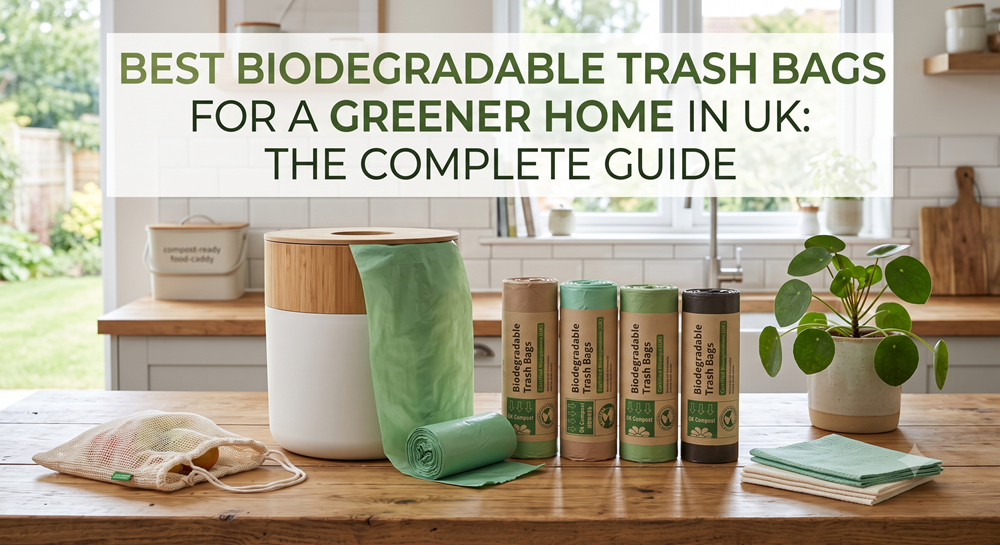
This comprehensive guide explores the best biodegradable trash bags available in the UK, helping you make an informed decision that’s both environmentally responsible and practical for your home.
What Are Biodegradable Trash Bags?
Clear Definition
Biodegradable trash bags are bin liners manufactured from materials that naturally break down in the environment through the action of microorganisms. Unlike conventional plastic bags, which can take 400-1,000 years to decompose, biodegradable bags typically degrade within 12-24 months under appropriate conditions.
How Biodegradable Bags Work
Biodegradable bags are usually made from plant-based materials such as:
- Polylactic Acid (PLA) – derived from corn starch or sugarcane
- Polybutylene Adipate Terephthalate (PBAT) – a biodegradable polyester
- Starch-based blends – combining traditional plastics with degradable additives
- Plant oils and cellulose – from renewable plant sources
These materials break down into water, carbon dioxide, and biomass, leaving no toxic residue behind.
Key Benefits of Biodegradable Trash Bags
- Reduced Environmental Impact – Decompose naturally without leaving microplastics
- Lower Carbon Footprint – Often manufactured from renewable resources
- Suitable for Composting – Many varieties are approved for home or industrial composting
- Reduced Landfill Burden – Saves valuable landfill space in UK waste management facilities
- Non-Toxic – No harmful chemicals released during breakdown
- Compliance with UK Regulations – Meets standards for single-use plastic reduction initiatives
Biodegradable vs. Compostable Trash Bags: What’s the Difference?
Head-to-Head Comparison
| Feature | Biodegradable Bags | Compostable Bags |
| Breakdown Time | 12-24 months in natural conditions | 90-180 days in industrial composting; 12+ months in home composting |
| Temperature Requirements | Works at standard temperatures | Requires specific temperature ranges (typically 50-60°C for industrial) |
| End Product | Organic matter, water, CO2 | Soil-like compost that enriches soil |
| Certification | Usually less stringent | Usually certified by BS EN 13432 or similar standards |
| Home Composting | Some varieties suitable | Specifically designed for composting systems |
| Landfill Use | Can still decompose in landfills | Best used in designated composting facilities |
| Cost | Generally more affordable | Typically more expensive due to certification |
| Versatility | General waste, organic waste | Best for food and garden waste |
Which Should You Choose?
- Biodegradable bags are ideal for general household waste and offer broader usability.
- Compostable bags are better if you have a home compost bin or access to local composting schemes, particularly for food waste.
What to Look for When Choosing Biodegradable Trash Bags
1. Check for UK and International Certifications
Look for these important certifications:
- BS EN 13432 – European standard for composability (the gold standard)
- OK Compost Home – Certifies bags suitable for home composting at lower temperatures
- OK Compost Industrial – For industrial composting facilities
- Vegan Certification – Ensuring no animal-derived materials
2. Material Composition
Verify the bag’s construction:
- 100% biodegradable materials are preferable to blends
- PBAT and PLA blends offer good durability and faster breakdown
- Thickness should be 30-50 microns for household use (thicker bags for heavier waste)
- Avoid bags containing oxo-degradable additives, which fragment into microplastics
3. Size and Capacity
UK households typically need:
- 18-20 litre bags for small kitchen bins
- 30-50 litre bags for standard household waste bins
- 60+ litre bags for large wheelie bins
Consider your bin size and waste volume before purchasing.
4. Strength and Durability
Quality indicators include:
- Puncture resistance – Can handle rough edges and sharp items
- Tear strength – Won’t split under typical waste loads
- Moisture resistance – Performs well with wet waste
- Temperature tolerance – Maintains integrity in various conditions
5. Cost Considerations
While biodegradable bags cost 20-40% more than conventional plastic, consider:
- Bulk buying reduces per-unit costs
- Subscription services offer regular delivery discounts
- Long-term environmental savings justify premium pricing
- Home composting options can offset costs through soil improvement
6. Supplier Reputation and Transparency
Choose brands that:
- Clearly state material composition
- Provide independent certifications
- Offer detailed product information
- Have positive environmental credentials
- Support UK-based manufacturing where possible
7. Environmental Claims Verification
Be cautious of:
- Greenwashing – Vague environmental claims without certification
- “Eco-friendly” labels without third-party verification
- Unsubstantiated degradation claims
Always verify certifications through official UK regulatory bodies.
Five Recommended Biodegradable Trash Bags for UK Homes
1. BioBag Compostable Bin Liners (30L and 50L)
Best For: Home composting enthusiasts
Key Features:
- Certified to BS EN 13432 and OK Compost Home
- Made from renewable plant sources (PBAT and starch blend)
- Suitable for home composting at 18-25°C
- 100% compostable in 180 days
- Available in rolls of 50 bags
Specifications:
- Sizes: 18L, 30L, 50L, 60L
- Thickness: 25 microns
Why Choose: BioBag is one of the UK’s most trusted compostable bag brands, with certifications recognised across Europe. Perfect if you use a home compost bin or have access to local composting schemes.
2. Ecobags Biodegradable Bin Liners
Best For: General household waste disposal
Key Features:
- Oxo-biodegradable technology (breaks down in 2-3 years)
- Made from plant-based materials with mineral additives
- Works in standard household conditions
- No artificial fillers
- Supplied in boxes of 100-200 bags
Specifications:
- Sizes: 20L, 30L, 50L, 60L
- Thickness: 35 microns
Why Choose: Ecobags offers excellent value for money and broader compatibility with UK waste systems. The slightly thicker material provides better durability for mixed household waste, including heavier items.
3. ECOFIT Compostable Kitchen Caddy Liners
Best For: Food waste and organic waste separation
Key Features:
- Certified for industrial and home composting
- Specifically designed for kitchen composting caddies
- Thin, flexible design that fits most UK council-supplied caddies
- PFAS-free (important for UK water systems)
- Compostable in 6 months in industrial facilities
Specifications:
- Sizes: Small (10L), Medium (15L), Large (20L)
- Thickness: 20 microns (lightweight)
Why Choose: ECOFIT aligns perfectly with UK council food waste collection schemes. Ideal if your local authority has implemented food waste separation programmes, which now covers most of England under the 2023 Environment Act.
4. Leaf Compostable Bin Bags
Best For: Environmentally conscious households seeking premium quality
Key Features:
- Made from certified renewable resources (plant-based plastic)
- Waterproof and strong (handles sharp edges well)
- Suitable for home and industrial composting
- British-made and ethically sourced
- Supporting UK green economy initiatives
Specifications:
- Sizes: 20L, 40L, 60L
- Thickness: 40 microns
- Price Range: £12-18 per roll
Why Choose: Leaf bags offer premium durability combined with environmental responsibility. Supporting a UK manufacturer reduces transportation emissions and supports the local green economy. Excellent for households wanting to invest in quality sustainable products.
5. Bastion Certified Compostable Liners
Best For: Households with varied waste types and composting access
Key Features:
- Industrial and home composting certified
- Extra-strong formulation (50 microns)
- Handles mixed waste including wet items
- PEFC-certified sustainable sourcing
- Available in bulk quantities with subscription options
Specifications:
- Sizes: 25L, 40L, 60L
- Thickness: 50 microns (premium strength)
- Price Range: £14-20 per roll (bulk discounts available)
Why Choose: Bastion provides the strongest compostable option for UK homes dealing with diverse waste types. The extra thickness prevents punctures and tears, offering better value despite higher upfront costs. Subscription options make them practical for regular use.
How to Use Biodegradable Bags Effectively
In Regular Household Bins
- Line your standard waste bin as you would with conventional bags
- Fill with mixed household waste
- Dispose in general waste collection
- The bag will biodegrade in landfill conditions over time
For Food Waste Collection
- Use smaller compostable bags (10-15L)
- Line your council-supplied food waste caddy
- Fill with food scraps and soiled paper
- Dispose in your local authority’s food waste collection
- The entire bag (and contents) will be composted industrially
For Home Composting
- Select bags certified for home composting (OK Compost Home)
- Use for organic kitchen waste (vegetable peelings, grass clippings)
- Place bag and contents directly in compost bin
- The bag will break down with other composting materials in 12-18 months
Storage Tips
- Keep bags in a cool, dry place away from direct sunlight
- Store away from extreme heat to prevent degradation
- Use bags within 2 years of purchase for optimal performance
Cost Comparison: Biodegradable vs. Conventional Bags
Annual Cost Analysis for Average UK Household
Conventional Plastic Bags:
- Cost per box (100 bags): £2-3
- Monthly usage: 1-2 boxes
- Annual cost: £24-36
Biodegradable Bags:
- Cost per roll (50 bags): £8-12
- Monthly usage: 1-2 rolls
- Annual cost: £96-144
Investment Difference: £60-108 annually (approximately £1.15-2.08 per week)
Return on Investment
Consider these factors:
- Environmental Impact Value – Reduced landfill contribution
- Health Benefits – Lower toxin exposure
- Long-term Costs – Potential waste levy reductions as UK policy evolves
- Quality of Life – Peace of mind from sustainable choices
UK Regulations and Environmental Policies
Recent UK Legislation Affecting Trash Bags
Environment Act 2021:
- Establishes framework for single-use plastic reduction
- Empowers local authorities to set waste targets
- Supports expansion of food waste collection schemes
Extended Producer Responsibility (EPR):
- Scheduled to launch in 2025
- Will increase accountability for packaging waste
- May increase costs for conventional plastic bags
- Makes biodegradable bags more cost-competitive
Local Authority Food Waste Collections:
- Now mandatory in England for properties with 4+ waste containers
- Rolling out across Scotland and Wales
- Creates demand for compostable caddy liners
Compliance Advantages
Using certified biodegradable bags helps your household comply with emerging UK environmental standards and supports compliance-ready waste management practices.
Environmental Impact Comparison
Carbon Footprint Analysis
| Metric | Conventional Plastic | Biodegradable Bags |
| Manufacturing Emissions | 2-3 kg CO2 per 1,000 bags | 1.5-2.5 kg CO2 per 1,000 bags |
| End-of-Life Emissions | Minimal (doesn’t decompose) | 0.5-1 kg CO2 per 1,000 bags (during decomposition) |
| Total Lifecycle | Higher long-term impact | 15-30% lower overall |
| Microplastic Generation | High (fragments indefinitely) | Negligible (proper decomposition) |
Landfill Space Savings
- Conventional bags take 400+ years to decompose
- Biodegradable bags free up landfill space within 2 years
- UK landfill capacity is limited; every reduction matters
FAQs: Biodegradable Trash Bags UK
Q1: Will biodegradable bags decompose in my regular household bin?
A: Yes, biodegradable bags will eventually decompose in landfill conditions, though it may take longer than in optimal conditions. However, anaerobic landfill environments (without oxygen) slow decomposition. For faster breakdown, compostable bags are better suited to composting facilities or home compost bins. If your local authority collects food waste, using compostable bags for those collections provides the fastest decomposition.
Q2: Are biodegradable bags really better for the environment?
A: Yes, significantly. Biodegradable bags break down into natural materials (water, CO2, and organic matter) within 2 years, compared to 400+ years for conventional plastic. They don’t fragment into microplastics, don’t accumulate in oceans, and consume fewer non-renewable resources during manufacturing. The UK Government’s environmental reports confirm biodegradable alternatives reduce landfill strain and environmental toxicity.
Q3: Can I use compostable bags in regular waste bins?
A: Yes, you can. Compostable bags will eventually break down in any environment, including landfills, though decomposition is faster in composting conditions. However, to maximise environmental benefit, it’s best to use compostable bags in:
- Home compost bins
- Local authority food waste collections
- Industrial composting facilities
Q4: What’s the difference between BS EN 13432 certified and non-certified bags?
A: BS EN 13432 (or equivalent certifications like OK Compost) is a European standard ensuring bags:
- Decompose in 90-180 days in industrial conditions
- Leave no toxic residue
- Don’t contain heavy metals or microplastics
- Meet rigorous testing requirements
Non-certified bags may degrade, but decomposition speed and quality are unverified. Always look for certification to ensure authenticity.
Q5: How much do biodegradable bags cost compared to plastic?
A: Biodegradable bags cost approximately 30-50% more upfront. However, the price gap is narrowing as:
- Manufacturing scales up
- Bulk buying discounts are available
- Subscription services offer cheaper rates
- Conventional bags will likely increase in price due to emerging UK regulations and EPR schemes
For most UK households, the additional cost is £5-10 per month.
Q6: Can biodegradable bags handle heavy or sharp waste?
A: Quality biodegradable bags (30-50 microns thick) are as strong as conventional bags and can handle:
- Sharp objects (broken glass, metal)
- Heavy items (tins, bottles)
- Wet waste (damp food scraps)
Thinner bags (20 microns) are better for organic waste only. Choose the appropriate thickness for your waste type.
Q7: Do biodegradable bags work in hot weather?
A: Yes, quality biodegradable bags are manufactured to resist degradation at normal temperatures. However:
- Store bags in cool, dry places away from direct sunlight
- Extreme heat (above 60°C) can accelerate degradation
- Most UK homes don’t experience sustained high temperatures
- Bags remain functional for the 2+ years before disposal
Q8: Are there any biodegradable bags made in the UK?
A: Yes, several manufacturers produce biodegradable bags in the UK, including Leaf and other specialist suppliers. UK-made bags:
- Reduce transportation emissions
- Support the local green economy
- Often use sustainable local sourcing practices
- May meet higher environmental standards
Search for “UK-made biodegradable bags” to find local suppliers.
Q9: Will my local council accept biodegradable bags in food waste collections?
A: Most UK councils explicitly request compostable bags for food waste caddies, particularly where they operate industrial composting facilities. Check your local authority’s website for specific requirements. Some councils provide guidance stating:
- Bags must be certified compostable
- Bags must meet BS EN 13432 standards
- Non-certified bags should be removed before composting
Always verify local requirements before purchasing.
Q10: How should I store biodegradable bags at home?
A: Store biodegradable bags:
- In a cool, dry location (not near radiators or windows)
- Away from direct sunlight
- In original packaging if possible
- At temperatures between 5-25°C
- For up to 2 years from purchase
Proper storage prevents premature degradation and ensures bags remain effective when needed.
Q11: Can biodegradable bags be recycled?
A: Most biodegradable and compostable bags cannot go in standard recycling bins, as they contaminate conventional plastic recycling streams. Instead:
- Compostable bags should go in food waste collections or home compost
- Biodegradable bags should go in general waste
- Check your local authority’s guidelines
- Some specialist composting schemes may accept certified bags separately
Never put compostable bags in plastic recycling bins.
Q12: What happens if biodegradable bags aren’t disposed of properly?
A: Even if biodegradable bags end up in inappropriate environments:
- They won’t accumulate like conventional plastic
- They won’t fragment into microplastics
- They’ll eventually decompose naturally
- They pose less risk to wildlife than conventional bags
However, proper disposal maximises environmental benefit and supports circular economy principles.
Q13: Are there any downsides to using biodegradable bags?
A: Minor considerations include:
- Higher cost – 30-50% more expensive initially
- Shorter shelf life – Degrade within 2-3 years of purchase
- Limited availability – Not stocked in all supermarkets
- Reduced strength (some types) – Thinner varieties handle less weight
- Specific disposal requirements – Different handling for compostable varieties
These drawbacks are minimal compared to environmental benefits.
Q14: Do biodegradable bags still produce methane in landfills?
A: Biodegradable bags do produce some methane during anaerobic decomposition in landfills, similar to organic waste. However:
- Modern UK landfills capture methane for energy generation (converting it to electricity)
- Methane emissions are temporary (bags decompose within 2 years)
- Conventional bags never decompose and never produce methane, but persist indefinitely
- The overall environmental impact of biodegradable bags remains far superior
This is why using compostable bags with food waste collections (which skip landfills entirely) is most environmentally beneficial.
Q15: Can I use biodegradable bags with my local council’s waste collection?
A: Yes, in most cases. However:
- Councils primarily focus on bag contents, not bag material
- Compostable bags are essential for food waste collections
- Biodegradable bags work fine in general waste collections
- Some councils prefer standard plastic for operational efficiency (as they’re not collecting the bags)
- Always check your local authority’s website for specific guidance
Using biodegradable bags in general waste is fine; using them in food waste collections is often specifically requested.
Making the Switch: Action Plan for UK Households
Step 1: Assess Your Waste Streams (Week 1)
- Determine your household’s waste composition
- Check if you have access to food waste collection
- Identify whether you have a home compost bin
Step 2: Choose Your Biodegradable Solution (Week 2)
- Select bags based on your waste streams (review our recommendations)
- Check local availability or order online
- Consider bulk buying for better value
Step 3: Implement Gradually (Week 3-4)
- Start with one waste stream (e.g., food waste)
- Monitor performance and adjust if needed
- Expand to other bins as you gain confidence
Step 4: Optimise Your System (Month 2+)
- Subscribe to regular deliveries for savings
- Share knowledge with neighbours
- Track your environmental impact
Step 5: Stay Informed
- Monitor UK regulations changes
- Stay updated on local authority schemes
- Explore new product innovations
The Bottom Line
Switching to biodegradable trash bags is one of the most practical and impactful environmental decisions UK households can make. With growing regulatory support, increasing availability, and narrowing price gaps, there has never been a better time to make the change.
Key Takeaways:
- Biodegradable bags decompose within 2 years, versus 400+ years for plastic
- Compostable bags are certified to specific standards for faster, verified breakdown
- Multiple options suit different household waste streams
- UK regulations increasingly favour sustainable alternatives
- The environmental investment pays dividends for future generations
Start with one or two bags from our recommended list, and experience the positive impact on your home’s environmental footprint.
Additional Resources for UK Households
Official UK Guidance
- GOV.UK Waste & Recycling: www.gov.uk/guidance/waste-and-contaminated-land
- Environment Agency: Guidance on waste disposal standards
- Your Local Authority Website: Food waste collection and recycling schemes
Certification Bodies
- OK Compost Certification: Verifies compostable bag standards
- British Standards Institution: BS EN 13432 standard information
Environmental Organisations
- Ellen MacArthur Foundation: Circular economy principles
- Friends of the Earth: UK environmental campaigns
- Keep Britain Tidy: Local waste initiatives
Connect With Us
Have you made the switch to biodegradable bags? Share your experience and tips with our community. Every small step contributes to a greener UK.
Last Updated: September 2026 Reviewed By: Environmental Sustainability Team
Disclaimer: Product recommendations are based on availability and certifications as of September 2026. Prices and availability may vary by retailer and region. Always verify current certifications and local authority requirements before purchase.

Author: Sustainable Talks
Talk Green. Think Change. Act Sustainably. 🌍 Ideas, stories & actions for a greener future.