



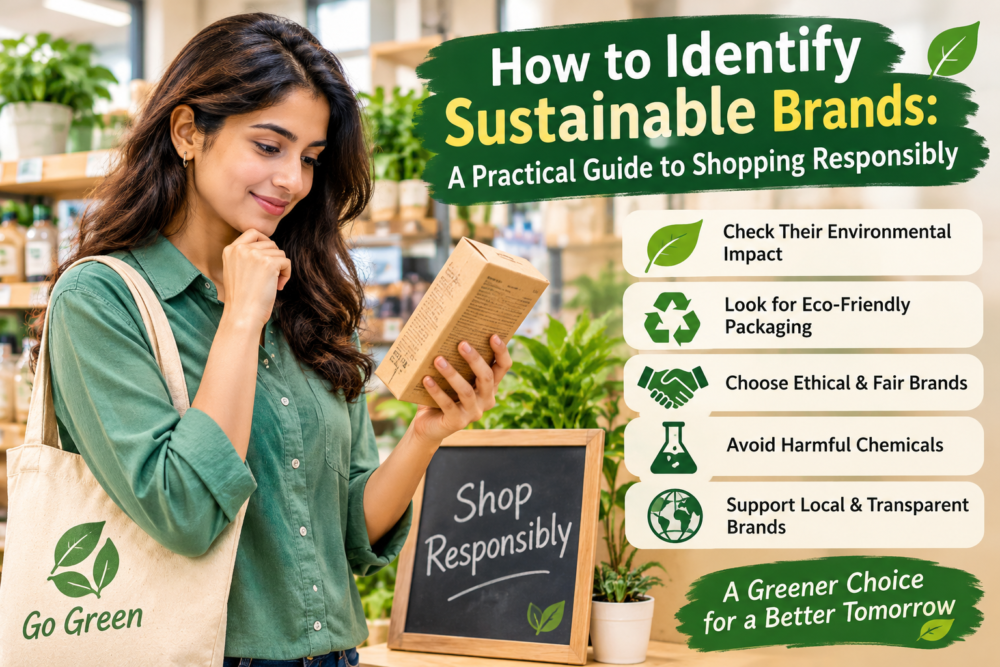
Have you ever purchased a product because its packaging looked natural, its label said “eco-friendly,” or its advertising promised a greener lifestyle? You’re not alone. As environmental awareness grows, more businesses are promoting their products as sustainable. However, not every brand that uses green packaging or environmental messaging follows genuinely sustainable practices.
Learning how to identify sustainable brands helps you make informed purchasing decisions, support responsible businesses, and avoid misleading environmental claims. Whether you’re shopping for skincare, clothing, household cleaning products, furniture, or everyday essentials, understanding what makes a product sustainable can help you look beyond marketing.
The good news is that you don’t need to be an environmental expert to recognise more responsible brands. By checking materials, certifications, packaging, supply-chain transparency, and company policies, you can make better choices that suit your needs and budget.
In this guide, we’ll explore practical ways to identify ethical brands, evaluate eco-friendly products, understand sustainable product certifications, and recognise common greenwashing signs.
1. Look Beyond Green Packaging and Marketing
One of the easiest mistakes consumers make is assuming that a product is sustainable because it has green colours, nature-inspired images, or words such as “natural” and “planet-friendly” on its packaging.
These visual and verbal cues can create a positive impression, but they don’t necessarily prove that a company follows environmentally responsible practices.
A genuinely sustainable brand should be able to explain what makes its products better for the environment and provide evidence to support its claims.
For example, a cleaning product might use recycled packaging but contain ingredients that raise other environmental concerns. Similarly, a clothing brand might advertise an organic cotton collection while providing little information about its other materials or manufacturing practices.
Neither example automatically makes the product a poor choice. The important point is to examine the specific benefit being claimed rather than assuming that one sustainable feature makes the entire product sustainable.
What to check:
- Does the brand explain its environmental claims clearly?
- Does it identify the specific materials or practices that make a difference?
- Is supporting information available on its website?
- Does the claim apply to the entire product, one ingredient, or just the packaging?
The more specific and verifiable the information, the easier it is to evaluate the brand fairly.
2. Check the Materials Used in Products
Materials are an important starting point when comparing sustainable products. The resources used to manufacture an item, their origin, the production process, and what happens at the end of the product’s life can all affect its environmental impact.
However, no material is automatically the most sustainable in every situation.
Look for recycled or responsibly sourced materials
Depending on the product category, useful options may include recycled metals, recycled paper, recycled plastics, responsibly sourced wood, or organic and recycled textiles.
Check whether the company explains the percentage of recycled or certified material used. A product made with 30% recycled content, for example, should not be interpreted as being entirely recycled.
For wooden furniture and paper products, look for information about sourcing and forest management. For textiles, check the fibre composition and whether the brand explains how its materials are produced.
Consider durability and product lifespan
A product that lasts for years may be a better purchase than a cheaper alternative that needs frequent replacement.
Look for durable construction, repair services, replacement parts, and warranties where relevant. For clothing, consider stitching, fabric quality, versatility, and care requirements. For household products, look at whether individual components can be repaired or replaced.
Evaluate the complete product
Ask whether the material is suitable for its intended use and whether the product can realistically be reused, recycled, or disposed of responsibly.
For example, a reusable item may be beneficial when used regularly over time, but buying several reusable products you don’t need can create unnecessary consumption.
The goal is to choose products that meet your needs while avoiding unnecessary resource use.
3. Understand Sustainable Product Certifications
Sustainable product certifications can make shopping easier by providing an independent standard against which certain products or business practices can be assessed.
However, certifications differ in their scope. Some focus on materials, others on manufacturing, forestry, chemical management, animal welfare, or working conditions. A certificate covering one issue doesn’t automatically establish that a brand is sustainable in every respect.
Here are some examples worth understanding.
Global Organic Textile Standard (GOTS)
GOTS is a textile-processing standard covering organic fibres and specified environmental and social criteria throughout relevant stages of textile processing and manufacturing.
It can be useful when evaluating organic textile products, but consumers should check the product’s actual certification and the scope of the standard.
Forest Stewardship Council (FSC)
FSC certification relates to responsible forest management and the sourcing or chain of custody of forest-based materials, depending on the certification.
It can help consumers evaluate certain paper and wood products. Check the specific label and claim rather than assuming every product from a company is FSC-certified.
Fairtrade
Fairtrade standards focus on trading relationships and conditions for participating producers and workers, with requirements that vary by product and certification scheme.
Fairtrade certification can be relevant when shopping for certain agricultural products and other covered goods. It primarily addresses social and economic trading conditions rather than every environmental aspect of a product.
OEKO-TEX
OEKO-TEX offers several certification and testing schemes. For example, STANDARD 100 focuses on testing textiles for harmful substances against specified criteria.
It can be useful when evaluating textiles, but it should not automatically be treated as proof that a product is organic, carbon-neutral, or sustainably manufactured in every respect.
How to verify a certification
Before trusting a logo, ask three questions:
- Who issued it? Look for a recognised organisation with publicly available standards.
- What does it cover? Check whether the certification relates to materials, chemicals, manufacturing, labour conditions, or another specific issue.
- Can the claim be verified? Where possible, use the certifier’s official website or database to check the certification and its scope.
Third-party certification can provide useful evidence, but brands remain responsible for substantiating their other environmental claims. The US Federal Trade Commission explains why certification seals should communicate their basis clearly and why certifications don’t automatically prove every claim a marketer makes. Read the FTC’s environmental marketing guidance.
4. Examine Packaging and Waste Reduction Practices
Packaging is another useful indicator when comparing brands, especially for cosmetics, food, cleaning products, and household essentials.
However, packaging should be evaluated alongside the product itself rather than used as the only measure of sustainability.
Look for practical packaging improvements
A brand may reduce packaging waste by offering:
- Refillable containers and accessible refill systems.
- Recycled-content packaging with clearly stated percentages.
- Packaging made from fewer material types where practical.
- Concentrated products that require less packaging per use.
- Durable containers designed for repeated use.
Consider whether the alternative is genuinely practical. A refillable product is most useful when refills are readily available and the original container can be used repeatedly.
Understand recyclable and compostable claims
A package described as recyclable may not be accepted by recycling facilities in your area. Similarly, some compostable products require specialised industrial facilities rather than a home compost bin.
Check local disposal options before relying on these claims.
Consider the amount of packaging
Excessive wrapping, unnecessary plastic components, and oversized boxes can be reasons to investigate a brand’s packaging choices.
Still, the lightest package isn’t necessarily always the best option. Packaging also protects products from damage and spoilage, so the overall design and intended use matter.
The US Federal Trade Commission advises businesses to make environmental claims specific and substantiated, including claims about recycled content, recyclability, and compostability. Explore the FTC’s guidance.
5. Investigate Supply-Chain Transparency
A brand’s sustainability extends beyond the finished product. It also involves the people, facilities, materials, and processes involved in producing and distributing it.
Responsible companies should be willing to share meaningful information about their supply chains, within reasonable limits.
Find out where products are made
Look for information about manufacturing locations, material sourcing, and supplier relationships. A country-of-origin label can be useful, but it doesn’t tell you everything about working conditions or environmental performance.
Brands that publish supplier lists, sourcing policies, or manufacturing standards provide additional information that consumers can examine.
Look for ethical labour practices
Ethical brands should take worker welfare seriously. Relevant information may include workplace safety policies, supplier codes of conduct, labour standards, grievance procedures, and independent assessments.
A statement saying “we care about our workers” is less informative than a published policy explaining how the company evaluates suppliers and responds to violations.
Check for measurable progress
Some companies publish sustainability reports or progress updates that describe their environmental goals, performance indicators, and areas requiring improvement.
Useful disclosures might include reductions in manufacturing emissions, water use, packaging waste, or the proportion of responsibly sourced materials.
Not every small business will have a detailed sustainability report. Smaller brands may instead provide clear product information, supplier details, and practical explanations of their production methods.
Tip: Transparency doesn’t mean a company must be perfect. A brand that acknowledges its limitations and explains how it intends to improve may provide more useful information than one making sweeping claims without evidence.
6. Learn to Recognise Greenwashing Signs
Greenwashing happens when a business creates a misleading impression about its environmental performance or the benefits of its products.
Recognising common greenwashing signs can help you avoid being influenced by marketing alone.
Vague environmental claims
Words such as “green,” “clean,” “natural,” and “eco-friendly” may sound reassuring, but they don’t explain precisely what environmental benefit a product offers.
Look for supporting details, such as the percentage of recycled material, a clearly defined reduction in packaging, or the specific standard a product meets.
Unverified badges and certification logos
Some businesses display leaf symbols, green ticks, or self-created environmental badges that resemble official certifications.
Before trusting a logo, investigate the organisation behind it and determine whether an independent assessment actually took place.
Claims focused on one small benefit
A brand may highlight a recycled box while providing no information about the product’s materials, production, or disposal.
The recycled box may still be a positive feature, but it shouldn’t be treated as proof of overall environmental responsibility.
Unsupported carbon-neutral claims
Carbon-related claims can depend on complicated calculations, emissions boundaries, and offset programmes.
If a company advertises a carbon-neutral product or service, look for an explanation of which emissions are included, how reductions are measured, and whether offsets are used.
No evidence behind big promises
Be cautious when brands promise dramatic environmental improvements but provide no data, methodology, independent verification, or clear explanation.
The FTC’s environmental marketing guidance warns against broad, unqualified claims of general environmental benefit because consumers may interpret them as promising much more than a business can substantiate.
A simple rule: When a claim sounds impressive, look for evidence that explains exactly what it means.
7. Evaluate the Brand’s Overall Environmental Commitment
Individual products matter, but a company’s wider policies can help you understand whether sustainability is integrated into its business practices.
Visit the brand’s website and look for a sustainability page, environmental policy, responsible sourcing statement, or published report.
Consider the following questions:
- Does the company have clear, measurable environmental goals?
- Does it explain how it plans to achieve those goals?
- Does it provide updates on its progress?
- Does it offer repairs, replacement parts, refills, or take-back programmes where appropriate?
- Does it address social responsibility and worker welfare?
- Does it acknowledge areas where improvement is still needed?
You can also examine the brand’s product range. If it promotes one eco-friendly product but offers little information about its broader practices, investigate the specific product rather than making assumptions about the entire company.
Remember that sustainability is a broad concept. Environmental impact, ethical sourcing, product durability, labour conditions, and waste management are related but distinct considerations.
8. Compare Brands Before Making a Purchase
Once you’ve gathered information, compare a few brands rather than relying on the first product with a green label.
For example, when shopping for a reusable water bottle, consider material safety, durability, expected lifespan, repairability, packaging, and the manufacturer’s sourcing information.
When buying clothing, examine fibre composition, durability, manufacturing disclosures, relevant textile certifications, and repair or resale options.
For cleaning products, consider ingredients, packaging, refill availability, usage instructions, and the evidence behind environmental claims.
You don’t need to investigate every detail for every purchase. Focus on the factors most relevant to the product and use reliable information to make a reasonable comparison.
Sustainable brand evaluation checklist
Use this checklist when researching a brand:
- Materials and ingredients are clearly disclosed.
- Environmental claims are specific and supported by evidence.
- Relevant certifications can be verified.
- Packaging choices and disposal instructions are explained.
- Manufacturing and sourcing information is available.
- Worker welfare and ethical sourcing are addressed.
- The company provides evidence of measurable progress.
- Product durability, reuse, or repair options are considered.
The more boxes you can confidently check, the more information you have to support your decision. This is a practical guide, not an official sustainability rating.
Final Thoughts: Choose Brands That Back Up Their Claims
Learning how to identify sustainable brands is an important step towards more responsible shopping. By examining materials, verifying sustainable product certifications, evaluating packaging, investigating supply chains, and recognising greenwashing signs, you can make better-informed decisions.
You don’t have to find a perfect brand or change every purchasing habit immediately. Start with the products you buy most frequently, ask questions when information is missing, and support businesses that communicate honestly about their environmental impact.
Sustainability is not just about selling products with attractive green packaging. It is about making thoughtful choices, providing credible evidence, and continually improving how products are designed, produced, used, and disposed of.
Are you a sustainability expert, eco-friendly business owner, or responsible brand with practical insights to share? Sustainables Talks welcomes relevant contributions that help readers make informed, sustainable lifestyle choices.
Visit our Write for Us page to explore guest contribution opportunities and share your knowledge with our readers.
Frequently Asked Questions
Start by checking the product’s materials, environmental claims, relevant certifications, packaging, and company website. Prioritise specific, verifiable information over green colours or general marketing promises.
The most relevant certification depends on the product. Examples include GOTS for covered organic textiles, FSC for specified forest-based products, Fairtrade for covered trading and producer standards, and OEKO-TEX STANDARD 100 for testing textiles against harmful-substance criteria.
Always verify the specific scheme and what it covers.
Not necessarily. Environmental impact depends on factors such as materials, manufacturing, transport, durability, use, and disposal. Compare the actual product and its intended purpose instead of relying on a single label.
Common warning signs include vague environmental promises, unsupported statistics, unclear certification logos, exaggerated carbon-neutral claims, and a focus on one small benefit without explaining the limitations.
These signs warrant further investigation, although they don’t automatically prove that a company is deliberately misleading consumers.
Yes. Certifications can provide useful independent verification, but smaller businesses can also offer transparent material information, responsible sourcing policies, durable products, reduced packaging, and measurable improvement plans.
Consumers should assess the evidence available rather than assuming that business size alone determines sustainability.

Author: Sustainable Talks
Talk Green. Think Change. Act Sustainably. 🌍 Ideas, stories & actions for a greener future.