





Austin has built its identity around a mix of live music, tech innovation, and a genuine love for the outdoors — Barton Springs, the Greenbelt, Lady Bird Lake. That outdoor culture has quietly turned into one of the most active green-building and conservation movements in Texas. Between a utility that has run a green building rating program since 1991, a city council goal to hit zero waste by 2040, and some of the strongest water-conservation rebates in the state, Austin gives beginners an unusually easy on-ramp into sustainable living.
This guide walks through what eco-friendly living actually looks like here — from your house and yard to your trash can — with the local programs, rebates, and plant lists that make Austin different from anywhere else.
Why Austin Is a Different Kind of Place to Go Green
Three things shape sustainable living in Austin more than almost any other factor:
- Heat and drought. Summers regularly hit triple digits, and Central Texas has cycled through serious droughts in recent years. That makes water conservation and cooling efficiency the two biggest levers for both your wallet and the environment.
- Local policy muscle. Austin Energy and Austin Water are municipally owned utilities, which means the city sets its own rebates, codes, and incentives rather than waiting on state or federal programs — and Texas offers no state income tax credits for green upgrades, so these municipal programs matter even more.
- Native landscape. Austin sits in the Texas Hill Country, on thin limestone soil with plants adapted to long dry spells. Working with that landscape instead of against it is the fastest way to cut water use.
Eco-Friendly Homes in Austin, Texas

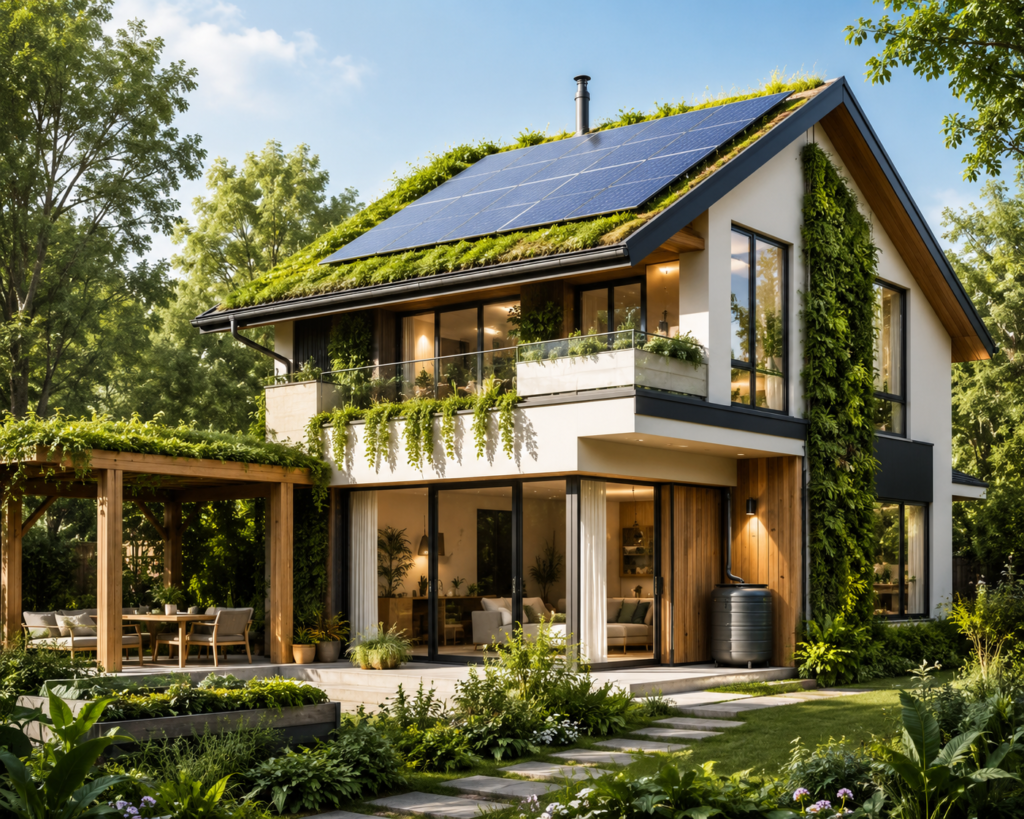
An eco-friendly home in Austin isn’t just about solar panels — it’s a whole-house approach to surviving the heat with less energy and less water.
Key Features of Eco-Friendly Homes
- High-performance insulation and air sealing. With attic temperatures that can exceed 150°F in summer, sealing air leaks and upgrading insulation is often the single highest-return improvement a homeowner can make.
- Efficient HVAC, especially heat pumps. Heat pumps handle both heating and cooling far more efficiently than traditional gas furnace/AC combos, which matters in a climate that needs cooling most of the year.
- Cool or reflective roofing. Light-colored or reflective roofing materials reduce heat gain, easing the load on air conditioning.
- Low-flow fixtures and greywater-ready plumbing. Given how often the region faces drought restrictions, indoor water efficiency is treated as a core feature, not an add-on.
- Native, drought-tolerant landscaping (more below) that eliminates the need for a thirsty lawn.
- Solar-ready design and, increasingly, home battery storage, which pairs well with Austin’s mostly mild-winter, high-sun-hours climate.
- Third-party green ratings. Homes built or remodeled under the <cite index=”8-1″>Austin Energy Green Building program, which developed the first sustainability rating system for buildings in the U.S. back in 1991</cite>, are evaluated on exactly these criteria for single-family, multifamily, and commercial projects.
Environmental Benefits
- Lower water draw on an already-stressed supply. Central Texas relies heavily on the Highland Lakes, which fluctuate with drought cycles — every gallon saved at home reduces pressure on that system.
- Reduced summer peak demand, which lowers strain on the regional power grid during the hottest months.
- Less stormwater runoff and erosion, especially important given Austin’s creeks and the Edwards Aquifer recharge zone that many suburbs sit above.
- Habitat support. Native landscaping restores food and shelter for pollinators and birds that have lost ground to turf lawns and non-native ornamentals.
How It’s Trending Right Now
Green building in Austin isn’t a niche hobby anymore — it’s increasingly baked into code and city planning. A few current signals:
- <cite index=”2-1″>The City of Austin updated its Energy Code to incorporate the 2024 International Energy Conservation Code with local amendments, effective July 10, 2025</cite>, pushing new construction toward tighter efficiency and EV-charging readiness by default.
- <cite index=”4-1″>Austin Energy Green Building is running a full update to its Single Family and Multifamily rating systems through 2026</cite>, with residents able to weigh in through the SpeakUp Austin platform.
- Heat pumps have become the go-to upgrade: <cite index=”1-1″>Austin Energy’s Power Saver program offers around a $3,000 rebate for a whole-home heat pump, 0% APR financing through Velocity Credit Union, and up to $800 for a heat pump water heater</cite>, which local installers describe as the strongest utility incentive package anywhere in the state now that the federal tax credit for heat pumps has expired.
- Passive House construction is gaining traction, including in affordable housing: the city has piloted incentives explicitly built around <cite index=”7-1″>Passive House certification, projected to deliver roughly 25% energy savings beyond the 2024 energy code baseline</cite>.
The Future of Eco-Friendly Homes in Austin
Expect the next few years to bring:
- Tighter code minimums as Austin continues rolling updated IECC standards into local requirements.
- More multifamily-focused programs, since apartments and condos house a huge share of the city’s fast-growing population and have historically lagged single-family homes on sustainability features.
- Wider adoption of battery storage, as homeowners pair solar with batteries to manage both high summer bills and the occasional grid strain during extreme heat or winter storms.
- Rainwater and greywater systems becoming standard on new builds in drought-prone parts of the metro, not just a retrofit option.
Eco-Friendly Landscaping in Austin
Landscaping is where Austin sustainability really shows up, because lawn irrigation is typically the biggest single use of residential water here. The city’s guidance is blunt: <cite index=”10-1″>upgrading to drought-friendly landscapes can reduce or end the need for extra watering</cite>.
What Austin-appropriate landscaping looks like:
- Xeriscaping with native and adapted plants — species like Texas sage, black-eyed Susan, Turk’s cap, agave, and native grasses that are built for limestone soil and long dry stretches.
- Turf reduction. <cite index=”12-1″>A WaterWise landscape reduces or eliminates the need for supplemental watering by adding compost and mulch to retain soil moisture, converting spray irrigation to drip or low-flow nozzles, and planting native or adaptive plants with lower water needs</cite>. <cite index=”12-1″>Turf typically needs about an inch of water weekly in summer, while mature native beds may need only half to three-quarters of an inch every other week</cite> — a dramatic cut in water use.
- Rain gardens and berms that capture rainfall on-site instead of letting it run off into streets and creeks.
- Rainwater harvesting tanks, which are increasingly common on Austin properties both for irrigation and, with proper treatment, household use.
- Mulch and compost over exposed soil, which locks in moisture and slashes how often you need to water.
Austin Water Rebates That Make This Affordable
This is where Austin genuinely stands out — the city pays you to xeriscape. Current programs include:
| Program | What It Covers | Rebate |
|---|---|---|
| WaterWise Landscape | Convert turfgrass to native/adapted plant beds | <cite index=”11-1″>Up to $1,750 for residential properties</cite> |
| Rainwater Harvesting | Tanks and equipment to capture rainwater | <cite index=”11-1″>Up to $5,000</cite> |
| WaterWise Rainscape | Berms, swales, rain gardens to keep rainwater on-site | <cite index=”11-1″>Up to $500 per property</cite> |
| Irrigation Upgrade | Smart controllers and efficient irrigation | <cite index=”11-1″>Up to $1,000</cite> |
| Landscape Survival Tools | Compost, mulch, core aeration | <cite index=”11-1″>Up to $120</cite> |
| Pressure Regulating Valve | Reduces household water pressure | <cite index=”11-1″>Up to $150</cite> |
| Watering Timers | Hose-end timers | <cite index=”11-1″>50% off, up to $40 for two timers</cite> |
A practical note on eligibility: for the turf-conversion rebate, <cite index=”12-1″>at least 75% of the area being converted must currently have healthy turf grass</cite>, since the program is designed to reduce water that’s actively being used. And if you’re near Waller Creek in North Central Austin, there’s an additional <cite index=”9-1″>Rain Catcher Pilot Program offering rebates and guidance specifically for rain gardens and cisterns</cite> in that watershed.
Zero Waste Living in Austin
Austin set an ambitious target back in 2011: <cite index=”20-1″>reduce the amount of trash sent to landfills by 90% by 2040</cite>, a goal the city calls Zero Waste. The philosophy behind it goes beyond recycling — <cite index=”20-1″>it focuses first on reducing trash and reusing products, then recycling and composting the rest</cite>.
Here’s what that means practically for an Austin household:
- Curbside composting is now widely available. <cite index=”19-1″>Austin Resource Recovery provides weekly curbside composting collection to single-family homes up to four-plexes</cite>, and because the material goes to a commercial facility, <cite index=”19-1″>residents can compost items like meat, dairy, seafood, and bones that typically can’t go in a backyard compost pile</cite>.
- Apartments are catching up. <cite index=”18-1″>Since October 1, 2024, the city has required multifamily properties — apartments, condos, non-state dorms, assisted living, and nursing homes — to provide residents and staff with convenient access to composting collection</cite>.
- Construction waste is regulated too. <cite index=”18-1″>A Construction and Demolition Recycling Ordinance requires general contractors on affected projects to reuse or recycle at least 50% of debris</cite>, which matters if you’re renovating a home.
- Special drop-off options. The city runs textile and clothing collection, a Recycle and Reuse Drop-off Center for hard-to-recycle items, household hazardous waste disposal, and even holiday tree recycling after Christmas.
- Progress is real but incomplete. It’s worth being honest here: a 2025 city audit found <cite index=”25-1″>only about 37% of waste was being diverted from landfills, well short of the roughly 85% pace needed to hit the 2040 target</cite>, with inconsistent standards among waste haulers cited as a factor. That’s actually useful context for a beginner — it means individual participation in composting and recycling programs genuinely moves the needle on a goal the city hasn’t yet hit on its own.
Beginner zero-waste habits that fit Austin life:
- Put out your compost cart weekly — check “My Schedule” on the city’s site for your pickup day.
- Buy from Austin’s robust refill and bulk shops (several are known nationally in zero-waste circles) instead of packaged goods.
- Use the Recycle and Reuse Drop-off Center for batteries, electronics, paint, and other items that don’t belong curbside.
- Compost yard trimmings instead of bagging them for landfill — leaves and grass clippings alone make up a large share of what’s needlessly discarded.
Tips to Make Your Home More Eco-Friendly in Austin
A practical starting checklist, roughly in order of impact-per-dollar for most Austin homes:
- Seal and insulate the attic first. Given the heat, this is usually the fastest payback of any upgrade.
- Apply for the Austin Energy heat pump rebate before replacing an aging HVAC system — combining the rebate with 0% financing significantly shortens payback time.
- Swap at least part of your lawn for native plants and claim the WaterWise Landscape rebate — even a partial conversion cuts your water bill noticeably.
- Add mulch and compost to garden beds — cheap, rebate-eligible, and immediately reduces watering frequency.
- Install a rain barrel or larger rainwater harvesting tank, especially if you already water a garden — the rebate can cover up to half the system cost.
- Put your composting and recycling carts to full use — check what’s accepted, since contamination (wrong items in the wrong bin) undermines the whole system.
- Install a smart irrigation controller if you have a sprinkler system — it adjusts watering based on weather instead of a fixed schedule.
- Consider solar with battery storage if your roof gets good sun exposure — Austin Energy offers separate solar PV incentives worth checking alongside any home electrification work.
- Use low-flow fixtures and fix leaks promptly — Austin Water’s leak-alert tools (through the My ATX Water portal) can flag unusual usage before it becomes a big bill.
- If building or remodeling, aim for an Austin Energy Green Building rating — it bundles most of the above into one certification process and can increase resale value.
FAQ: Sustainable Living in Austin, Texas
Is it expensive to make my Austin home eco-friendly?
Not necessarily. Between Austin Energy’s heat pump rebates, 0% financing, and Austin Water’s landscaping and rainwater rebates, many upgrades are partially or heavily subsidized. Insulation, mulching, and native planting are also some of the lowest-cost changes with the fastest payback in a hot climate.
What is the easiest first step toward sustainable living in Austin?
For most households, it’s cutting outdoor water use — either by converting part of a lawn to native plants or adding mulch to existing beds. It’s inexpensive, rebate-eligible, and shows up on your water bill almost immediately.
Does Austin have curbside composting for everyone?
Weekly curbside composting is currently available to single-family homes up through four-plexes, and multifamily properties (apartments, condos, and similar) have been required to offer residents composting access since October 2024. Coverage and rollout can vary by property, so check your building or the city’s collection schedule tool.
What plants work best for eco-friendly landscaping in Austin?
Native and drought-adapted species suited to Central Texas limestone soil — examples include Texas sage, Turk’s cap, black-eyed Susan, agave, and native bunch grasses. These need far less water than traditional turf once established.
Are there rebates for rainwater harvesting in Austin?
Yes. Austin Water offers rebates for rainwater harvesting systems, generally covering equipment costs up to a set cap per household, plus separate smaller rebates for rain gardens, berms, and other features that keep rainwater on your property instead of running off.
Is Austin actually on track to hit its zero-waste goal?
Not yet — recent city audits show landfill diversion running well below the pace needed to hit the 2040 target of a 90% reduction. That makes individual participation in composting and recycling more impactful, not less, since the city’s progress depends heavily on resident behavior.
Do I need a special permit for a rainwater harvesting tank?
Smaller systems (under 500 gallons) typically have minimal requirements, while larger or pressurized systems have additional rules around first-flush diversion, base construction, and cross-connection control. Rebate pre-approval is often required before you purchase equipment, so check current program guidelines before buying.
Programs, rebate amounts, and code requirements referenced above are run by the City of Austin, Austin Energy, and Austin Water, and are subject to change — always confirm current details on the relevant city or utility website before applying.

Author: Sustainable Talks
Talk Green. Think Change. Act Sustainably. 🌍 Ideas, stories & actions for a greener future.