




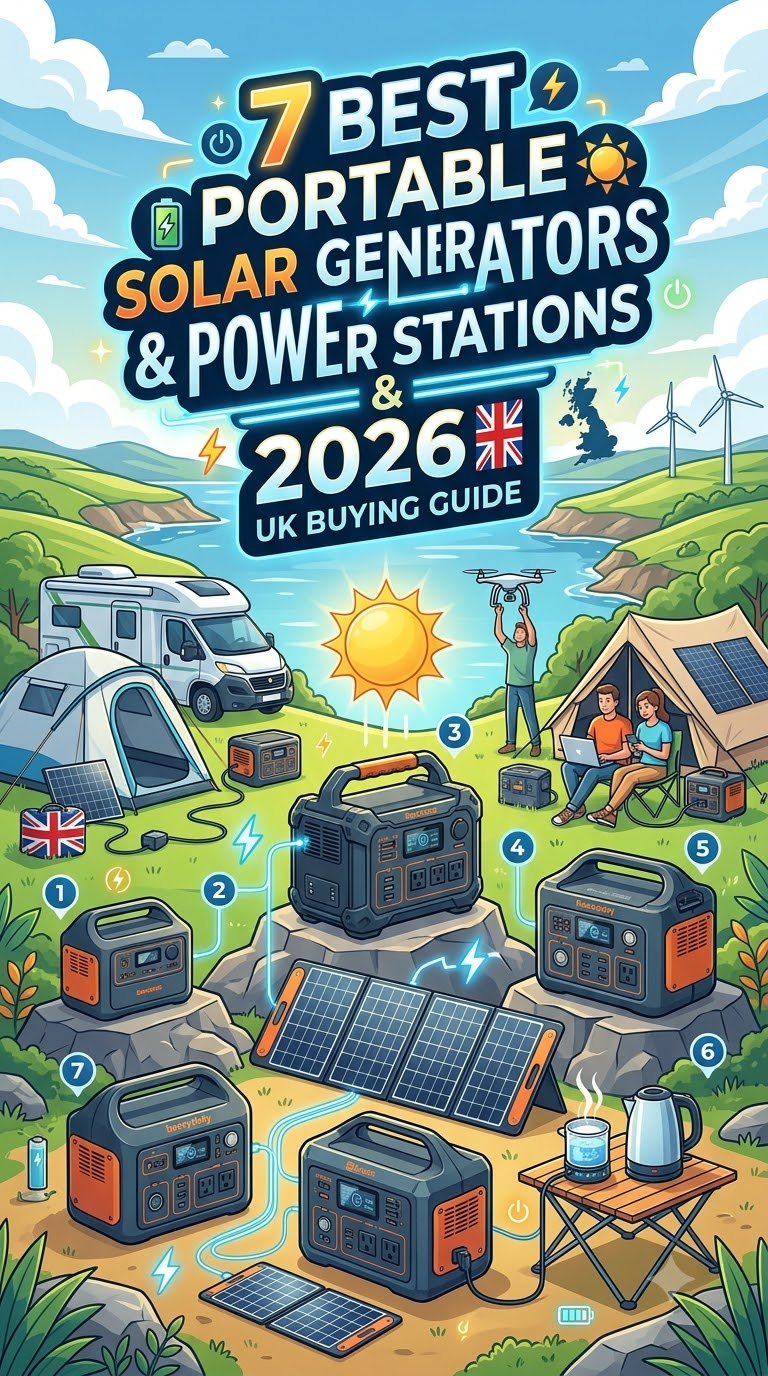
Power cuts, camping trips, van life and garden offices all have one thing in common in 2026: a LiFePO4 portable power station is now the default answer, not a petrol generator. Battery costs have fallen, solar input speeds have roughly doubled since 2023, and every major brand now sells a UK-spec unit with proper BS 1363 sockets.
This guide compares the seven best portable solar generators and power stations available in the UK right now, based on capacity, real-world AC output, solar charging speed and price per watt-hour.
Quick Answer
The best portable solar generator for most UK buyers is the EcoFlow DELTA 2 — it balances 1,024Wh capacity, 1,800W output and sub-hour mains charging at a price that undercuts most rivals. The best-value pick is the Anker SOLIX C1000, offering similar capacity for roughly £80 less. For lightweight camping and van life, the Jackery Explorer 1000 v2 is the pick, and for households that need to run a kettle, heater or power tool, the BLUETTI AC180 offers the highest continuous output in this list.
How We Compared These 7 Power Stations
| # | Model | Capacity | AC Output | Solar Input | Approx. UK Price | Best For |
| 1 | EcoFlow DELTA 2 | 1,024Wh | 1,800W | Up to 500W | £508 | Best all-rounder |
| 2 | Anker SOLIX C1000 (Gen 2) | 1,056Wh | 1,800W | Up to 500W | £429 | Best value |
| 3 | Jackery Explorer 1000 v2 | 1,070Wh | 1,500W (3,000W surge) | Up to 400W | £599–£649 | Lightest / best app |
| 4 | BLUETTI AC180 | 1,152–1,433Wh | 1,800W (2,700W Power Lifting) | Up to 500W | £499–£599 | Highest sustained output |
| 5 | EcoFlow RIVER 2 | 256Wh | 600W | Up to 110W | £209 | Compact camping / EDC |
| 6 | OUPES Exodus 2400 | 2,232Wh | 2,400W | Up to 1,000W+ | £849 | Home office / extended backup |
| 7 | BLUETTI Apex 300 | ~2,400Wh | 3,000W | Up to 1,200W | £1,199+ | Serious off-grid solar charging |
Prices fluctuate with retailer promotions — always check the current listing before buying.
1. EcoFlow DELTA 2 — Best Overall Portable Solar Generator
The EcoFlow DELTA 2 remains the benchmark against which every other station in this list gets measured. It packs a 1,024Wh LiFePO4 battery into a 12kg case, delivers 1,800W of continuous AC output (enough for a kettle or microwave), and charges from 0–80% in under an hour on the mains. Paired with EcoFlow’s plug-in solar panels, it also doubles as a home solar battery on days you don’t need it for backup power.
Why it works for the UK: EcoFlow’s charging speed matters more here than the marketed solar figures — UK sunshine hours (around 1,400 a year, per the Met Office) rarely deliver a panel’s full rated output, so a station that can top up quickly from the mains between cloudy days is more practical than one built solely for solar.
- Capacity: 1,024Wh (expandable to ~3kWh with extra battery packs)
- Output: 1,800W continuous
- Solar input: up to 500W (roughly 3–4 peak sun hours for a full charge with two 200–250W panels)
- Best for: power cuts, caravans, home office backup, first-time buyers
2. Anker SOLIX C1000 (Gen 2) — Best Value for Money
The Anker SOLIX C1000 is the sharpest price-to-performance pick on the market in 2026. At roughly £429 it delivers near-identical specs to the DELTA 2 — 1,056Wh capacity and 1,800W output — for around £80 less, and it charges fully from the mains in about 49 minutes, among the fastest in its class.
- Capacity: 1,056Wh
- Output: 1,800W continuous
- Solar input: up to 500W
- Best for: budget-conscious buyers who still want full-size capacity
3. Jackery Explorer 1000 v2 — Best Lightweight Station & App
Jackery built its reputation on reliability and simplicity, and the Explorer 1000 v2 continues that trend. At 10.8kg it’s the lightest 1,000Wh-class station on this list — around 5kg lighter than the BLUETTI AC180 — with a flush-folding handle that makes it easy to carry and stack in a car boot. Its 3,000W surge rating also makes it better than most rivals at starting inductive loads like power tools or a portable fridge compressor.
- Capacity: 1,070Wh
- Output: 1,500W continuous / 3,000W surge
- Solar input: up to 400W
- Best for: camping, van life, anyone who moves the unit often
4. BLUETTI AC180 — Best for High-Draw Appliances
If you need to run something genuinely power-hungry — a space heater, electric kettle or corded power tool — the BLUETTI AC180 has the headroom. Its 1,800W continuous rating and “Power Lifting” mode (which drops voltage to push output to 2,700W for resistive loads) give it more sustained muscle than the Jackery, at the cost of extra weight (around 16kg) and bulkier handles.
- Capacity: 1,152Wh (1,433Wh on the AC180T variant)
- Output: 1,800W continuous, up to 2,700W in Power Lifting mode
- Solar input: up to 500W
- Best for: heavy appliances, expandable off-grid setups (compatible with B80/B230/B300 add-on batteries)
5. EcoFlow RIVER 2 — Best Compact Power Station for Camping
Not every trip needs 1,000Wh. At 256Wh and 3.5kg, the EcoFlow RIVER 2 is built for charging phones, laptops, drones and small camping gear rather than running a fridge. It’s the cheapest station on this list at around £209 and still uses the same LiFePO4 chemistry and fast-charge tech as its bigger siblings.
- Capacity: 256Wh
- Output: 600W continuous
- Solar input: up to 110W
- Best for: festivals, day hikes, backpacks, minimalist van builds
6. OUPES Exodus 2400 — Best for Home Office & Extended Backup
For buyers who need serious capacity without stepping up to a fixed home battery, the OUPES Exodus 2400 offers 2,232Wh and a 2,400W AC output — enough to run a full home office setup, camping kitchen or an extended power cut for 24+ hours. OUPES’ fast-charge tech takes it from 0–80% in around 36 minutes, which is a genuine advantage if you need a rapid top-up before a trip or mid-outage.
- Capacity: 2,232Wh
- Output: 2,400W AC
- Solar input: 1,000W+
- Best for: home office backup, multi-day camping, small business continuity
7. BLUETTI Apex 300 — Best for Off-Grid Solar Charging
Most “solar generators” on this list are really mains-charging stations that can also accept a panel. The BLUETTI Apex 300 is built the other way round, with a high-wattage MPPT solar input designed to make the most of genuine off-grid charging — allotments, remote cabins and long-term van life. With around 1,200W of accepted solar input, it can recharge a large battery in a fraction of the time a 400–500W-input station would take.
- Capacity: ~2,400Wh (expandable)
- Output: 3,000W
- Solar input: up to 1,200W
- Best for: true off-grid setups where mains charging isn’t an option
How to Choose a Portable Solar Generator in the UK
1. Match capacity to what you’ll actually run. A 250–300Wh station covers phones, laptops and lights. You need 1,000Wh+ to run a fridge, kettle or heater for any length of time, and 2,000Wh+ for multi-day home backup.
2. Check the AC output, not just the battery size. A large battery with a small inverter still can’t run a kettle. Look for at least 1,800W continuous output if you want to run kitchen appliances.
3. Don’t oversell solar. UK daylight and cloud cover mean a “200W” panel typically delivers 100–140W in practice, and a full charge from panels alone can take most of a day. Treat solar as a strong top-up, not a replacement for mains charging, especially outside summer.
4. MPPT beats PWM. An MPPT charge controller extracts roughly 20–30% more usable power from the same panel than an older PWM controller, according to Victron Energy — worth checking before buying third-party panels.
5. Confirm connector compatibility. Most stations accept a wide DC voltage range (11–60V) via MC4 or XT60 connectors, so generic panels from Renogy, EcoWorthy or Allpowers will usually work with a cheap adaptor cable — you don’t have to buy the manufacturer’s matched panel set.
6. Weight matters more than the spec sheet suggests. A 16kg station is a very different daily-use proposition from a 10.8kg one if you’re loading it in and out of a car or carrying it up stairs during a power cut.
Frequently Asked Questions
What is the best portable solar generator in the UK for 2026?
For most UK households, the EcoFlow DELTA 2 is the best all-round choice, combining 1,024Wh of capacity, 1,800W output and fast mains charging at a competitive price. Budget buyers should look at the Anker SOLIX C1000, and campers who prioritise low weight should consider the Jackery Explorer 1000 v2.
How long does it take to charge a portable power station from solar panels in the UK?
It depends on panel wattage and weather. As a rough guide, a 200W solar panel typically delivers 100–140W in real UK conditions, so fully charging a 1,000Wh station can take most of a clear day, or considerably longer under cloud cover. Stations with higher-wattage MPPT solar input (500W+) charge proportionally faster.
Can a portable solar generator power a fridge or kettle?
Yes, provided its continuous AC output is rated at 1,500W or higher. Kettles typically draw 1,500–3,000W briefly, so check both the continuous and surge output ratings before buying.
Is it worth buying the manufacturer’s solar panels, or can I use a generic one?
Generic panels from brands like Renogy or EcoWorthy work fine with most stations as long as the voltage falls within the accepted DC input range and you use the correct connector or adaptor (usually MC4 or XT60). Manufacturer-branded panel kits are often priced at a premium for the same underlying hardware.
How many charge cycles do LiFePO4 power stations last?
Most current LiFePO4 (LFP) portable power stations are rated for 3,000–4,000 full charge cycles before dropping to 70–80% of original capacity — significantly longer than older lithium-ion (NMC) units, which typically last 500–800 cycles.
What size portable power station do I need for a UK power cut?
For essentials like a router, phone charging, LED lighting and a laptop over several hours, a 500–1,000Wh station is usually sufficient. For a fridge, heating pump or medical equipment running over a full day, look at 2,000Wh or higher, or a stackable/expandable system.
Brand & Product Spotlight
This guide is updated regularly as new portable power stations launch in the UK market. If you’re a manufacturer or distributor of solar generators, portable power stations or solar panels and would like your product considered for a future edition of this guide, comparison table or spotlight feature, get in touch with the team at Sustainable Talks. Sustainable Talks covers sustainable energy products, reviews and buying guides for UK consumers, and welcomes outreach from brands with genuine, UK-available stock.
Disclosure: Prices and specifications are correct at the time of writing and are subject to change — always verify current pricing and availability directly with the retailer before purchasing.

Author: Sustainable Talks
Talk Green. Think Change. Act Sustainably. 🌍 Ideas, stories & actions for a greener future.