


Cleaning your home does not have to mean filling your cupboards with single-use plastic bottles and harsh chemical products. With more refill options, concentrated formulas and reusable cleaning tools available across the UK, it is becoming easier to create a cleaning routine that produces less waste.
But with so many products marketed as “green”, “natural”, “eco” and “sustainable”, choosing the right products can be confusing.
So, what actually makes a cleaning product environmentally preferable? And how can you choose better options without spending a fortune?
This complete guide to eco-friendly cleaning products in the UK explains what to look for, which product categories to consider, how to avoid greenwashing and how to build a more sustainable cleaning routine at home.
What Are Eco-Friendly Cleaning Products?
Eco-friendly cleaning products are cleaning solutions designed or marketed to reduce certain environmental impacts compared with conventional alternatives.
These impacts can include the ingredients used, packaging, transportation, product concentration, manufacturing and disposal.
However, there is no single feature that automatically makes a cleaning product sustainable.
For example, a product may use plant-derived ingredients but come in excessive single-use packaging. Another product may use a synthetic ingredient but come in concentrated form that significantly reduces packaging and transportation requirements.
The best approach is therefore to consider the whole product, rather than relying on one marketing claim.
The UK Competition and Markets Authority advises consumers to look beyond vague environmental claims and consider evidence, packaging, disposal and the overall environmental impact of a product.
Common Features of Sustainable Cleaning Products
Depending on the product, useful features can include:
- Refillable packaging
- Concentrated formulas
- Reusable bottles
- Recyclable or recycled packaging
- Efficient product dosing
- Ingredients with appropriate environmental profiles
- Reduced packaging
- Durable reusable cleaning tools
- Recognised environmental certifications
- Clear disposal instructions
No single feature guarantees that a product is the most sustainable option, so compare the complete product rather than one claim.
Why Choose Eco-Friendly Cleaning Products in the UK?
Switching to more sustainable cleaning products in UK can help reduce waste and encourage more responsible consumption.
1. Reduce Single-Use Plastic
Traditional cleaning products are often sold in plastic bottles that need to be replaced repeatedly.
Refill systems and concentrated cleaners can reduce the number of bottles required over time.
Instead of purchasing a new spray bottle every time, you can keep a reusable bottle and simply add a refill or diluted concentrate.
2. Reduce Packaging Waste
Packaging can make up a significant part of a cleaning product’s environmental footprint.
Look for products that minimise unnecessary packaging and clearly explain how their packaging should be disposed of.
Remember that a claim such as “recyclable” does not necessarily mean that every part of the packaging will be accepted through your local household recycling system. Always check the disposal instructions and your local council guidance.
3. Choose Concentrated Products
Concentrated cleaning products can be useful because you transport less water and may need less packaging per application.
Some products are designed to be diluted at home, while others are sold as tablets or refills.
Always follow the manufacturer’s dilution and dosage instructions.
4. Support Better Consumption Habits
Sustainable cleaning is not only about buying a different bottle.
Using the correct amount of detergent, choosing reusable cloths and avoiding unnecessary disposable products can also reduce household waste.
Types of Eco-Friendly Cleaning Products
There are sustainable alternatives across almost every cleaning category.
Eco-Friendly Multi-Surface Cleaners
Multi-surface cleaners can be used on suitable kitchen, bathroom and household surfaces.
For a more sustainable option, look for:
- Refillable bottles
- Concentrated formulas
- Minimal packaging
- Clear ingredient information
- Suitable environmental certifications
A good multi-purpose cleaner can also help reduce the number of specialist cleaning products you need to buy.
Eco-Friendly Laundry Detergent
Eco Friendly Laundry detergent in Uk is one of the most frequently used cleaning products in many households.
When comparing sustainable laundry products, consider:
- Packaging
- Concentration
- Recommended dosage
- Ingredients
- Washing temperature
- Refill availability
- Certifications
Using the recommended amount is important. More detergent does not necessarily mean cleaner clothes.
Eco-Friendly Washing-Up Liquid
For washing dishes by hand, look for products that offer refill options, reduced packaging or concentrated formulas.
You can also make your routine more sustainable by using only the amount you need and choosing reusable washing-up tools rather than constantly replacing disposable sponges.
Eco-Friendly Dishwasher Tablets
When buying dishwasher tablets, consider both the product and its packaging.
Look for transparent information about:
- Ingredients
- Packaging
- Dosage
- Environmental certifications
- Disposal
Some ecolabel criteria for detergents and cleaning products also address product performance, chemical requirements and packaging-related considerations.
Eco-Friendly Bathroom Cleaners
Bathroom cleaning products include:
- Toilet cleaners
- Limescale removers
- Shower cleaners
- Glass cleaners
- General bathroom sprays
Choose products according to the surface and cleaning task rather than assuming that the strongest product is always the best choice.
Eco-Friendly Floor Cleaners
For floor cleaning, concentrate on finding a product that is appropriate for your flooring.
A refillable or concentrated floor cleaner can reduce packaging compared with repeatedly buying large quantities of ready-to-use solution.
Eco-Friendly Cleaning Products for Every Room
Sustainable Kitchen Cleaning
A simple kitchen cleaning kit could include:
- Refillable multi-surface cleaner
- Concentrated degreaser
- Sustainable washing-up liquid
- Reusable cloths
- Reusable scrubber
- Dishwasher detergent, if required
Avoid buying a separate product for every small cleaning task unless you genuinely need one.
Sustainable Bathroom Cleaning
A basic bathroom kit could include:
- Toilet cleaner
- Limescale remover
- Bathroom cleaner
- Reusable cloths
- Reusable scrubber
- Glass cleaner
Always check that a product is suitable for the specific surface before using it.
Sustainable Laundry Cleaning
A greener laundry routine can include:
- Concentrated or refillable detergent
- Reusable laundry accessories
- Correct dosing
- Washing at an appropriate temperature
- Avoiding unnecessary re-washing
The most sustainable choice depends on the product, the washing process and how frequently you use it.
Sustainable Living Room Cleaning
For living areas, you may only need:
- Multi-surface cleaner
- Glass cleaner
- Reusable dusting cloth
- Vacuum cleaner
- Washable cleaning cloths
Reducing the number of specialist products you buy can simplify your cleaning cupboard and reduce packaging.
Eco-Friendly Cleaning Ingredients to Look For
The word “natural” should not automatically be treated as a sustainability guarantee.
Instead, look for clear information about what a product contains and why those ingredients are used.
Plant-Derived Ingredients
Some cleaning products use surfactants or other ingredients derived partly or entirely from plants.
However, plant-derived does not automatically mean environmentally harmless. Consider the complete product and the manufacturer’s evidence.
Citric Acid
Citric acid is commonly used in household cleaning products, particularly products designed to tackle limescale.
Bicarbonate of Soda
Bicarbonate of soda is a popular household cleaning ingredient and can be useful for certain cleaning tasks.
Vinegar
Vinegar is widely used in DIY cleaning routines, particularly for some descaling and surface-cleaning applications.
However, it is not suitable for every surface.
Plant-Based Surfactants
Surfactants help cleaning products loosen and remove dirt and grease. Some are derived from plant-based raw materials.
Again, the term “plant-based” should be considered alongside sourcing, manufacturing, formulation and packaging.
Ingredients and Claims to Investigate Carefully
Rather than assuming every synthetic ingredient is harmful or every natural ingredient is safe, investigate the specific product.
Pay attention to:
- Fragrances
- Preservatives
- Disinfecting or biocidal ingredients
- Bleaching agents
- Ingredients associated with specific environmental concerns
- Usage and safety instructions
Cleaning products can contain ingredients that require appropriate handling, and products classified as hazardous must carry appropriate hazard information under applicable chemical-safety rules.
The key point is simple: read the label and follow the manufacturer’s instructions.
How to Choose Eco-Friendly Cleaning Products in the UK
Use this checklist before buying.
1. Check the Ingredients
Look for clear ingredient information and investigate unfamiliar ingredients when necessary.
2. Check the Packaging
Ask:
- Is the bottle reusable?
- Is there a refill option?
- Is unnecessary packaging being used?
- What parts can actually be recycled?
3. Look for Concentrates or Refills
Concentrates and refills can be an effective way to reduce packaging consumption.
4. Look for Credible Certifications
Independent environmental labels can provide more useful information than vague marketing slogans.
The EU Ecolabel, for example, uses product-specific criteria designed to address environmental impacts across a product’s lifecycle while also requiring performance standards.
5. Compare Cost Per Use
A £5 bottle is not necessarily cheaper than a £7 concentrate.
Instead, compare how many cleaning applications each product provides.
6. Check Disposal Instructions
Find out how to dispose of both the product and its packaging.
The CMA specifically recommends considering disposal rather than focusing only on how a product is marketed when purchased.
How to Avoid Greenwashing
Greenwashing occurs when environmental marketing gives consumers a misleading impression about a product’s environmental benefits.
Be cautious of broad claims such as:
- “100% eco-friendly”
- “Completely green”
- “Planet-friendly”
- “Zero impact”
- “Natural”
- “Sustainable”
These terms can be meaningful only when they are supported by clear evidence and context.
UK guidance states that broad claims such as “eco-friendly”, “green” and “sustainable” can be misleading when they are not properly explained or substantiated.
A Simple Greenwashing Checklist
Before buying, ask:
What exactly is the environmental benefit?
Is the claim about:
- Packaging?
- Ingredients?
- Carbon emissions?
- Water use?
- Manufacturing?
- Disposal?
Is there evidence?
Look for specific information rather than just a green logo or nature-inspired packaging.
Does the claim apply to the whole product?
For example, a product may have recyclable packaging while its other environmental impacts are less clear.
Can you understand how to dispose of it?
A recyclable or biodegradable claim should be accompanied by appropriate information where conditions apply.
Eco-Friendly Cleaning Products vs Conventional Products
| Feature | Eco-Friendly Options | Conventional Options |
|---|---|---|
| Packaging | Often designed around refills, reuse or reduced materials | Frequently sold in single-use packaging |
| Concentrates | Common in some product ranges | Less common |
| Refill options | Increasingly available | Less common |
| Ingredients | Varies by product | Varies by product |
| Environmental certifications | Available for some products | Available for some products |
| Price | Can be higher upfront | Wide range |
| Cost per use | Can be competitive with concentrates | Varies |
| Sustainability claims | Should be evidence-based | Should also be evidence-based |
It is important not to assume that every product labelled “eco” is automatically better than every conventional alternative.
The better comparison is product versus product, considering ingredients, packaging, performance, use and disposal.
How Much Do Eco-Friendly Cleaning Products Cost in the UK?
Sustainable cleaning products are available across different price points.
Budget Options
Look for:
- Basic concentrated cleaners
- Refillable products
- Simple reusable cleaning tools
- Supermarket own-brand sustainable ranges
Mid-Range Options
These may include:
- Refillable systems
- Concentrated detergents
- Sustainable cleaning bundles
- Products with recognised certifications
Premium Options
Premium products may offer:
- Specialist formulations
- Refill subscriptions
- Advanced packaging systems
- Higher-end ingredients
- Additional sustainability initiatives
Rather than comparing the shelf price alone, calculate the cost per use.
A concentrated product with a higher initial price may provide considerably more applications than a ready-to-use product.
Where Can You Buy Eco-Friendly Cleaning Products in the UK?
UK shoppers can find sustainable cleaning products through several channels.
Supermarkets
Large UK supermarkets increasingly stock products marketed around reduced plastic, refills, concentrated formulas or environmental certifications.
Check stores such as:
- Tesco
- Sainsbury’s
- Waitrose
- Morrisons
- ASDA
Availability varies by location.
Refill Shops
Zero-waste and refill shops can be useful if you want to reuse containers and purchase only the amount you need.
Search for local refill stores in your area and check which cleaning products they stock.
Online
Buying directly from a manufacturer’s website or a specialist sustainable retailer can provide more information about:
- Ingredients
- Packaging
- Refills
- Certifications
- Product instructions
Always check the claims and product information rather than relying solely on the retailer’s sustainability language.
How to Build a Sustainable Cleaning Kit
You do not need dozens of products to clean your home effectively.
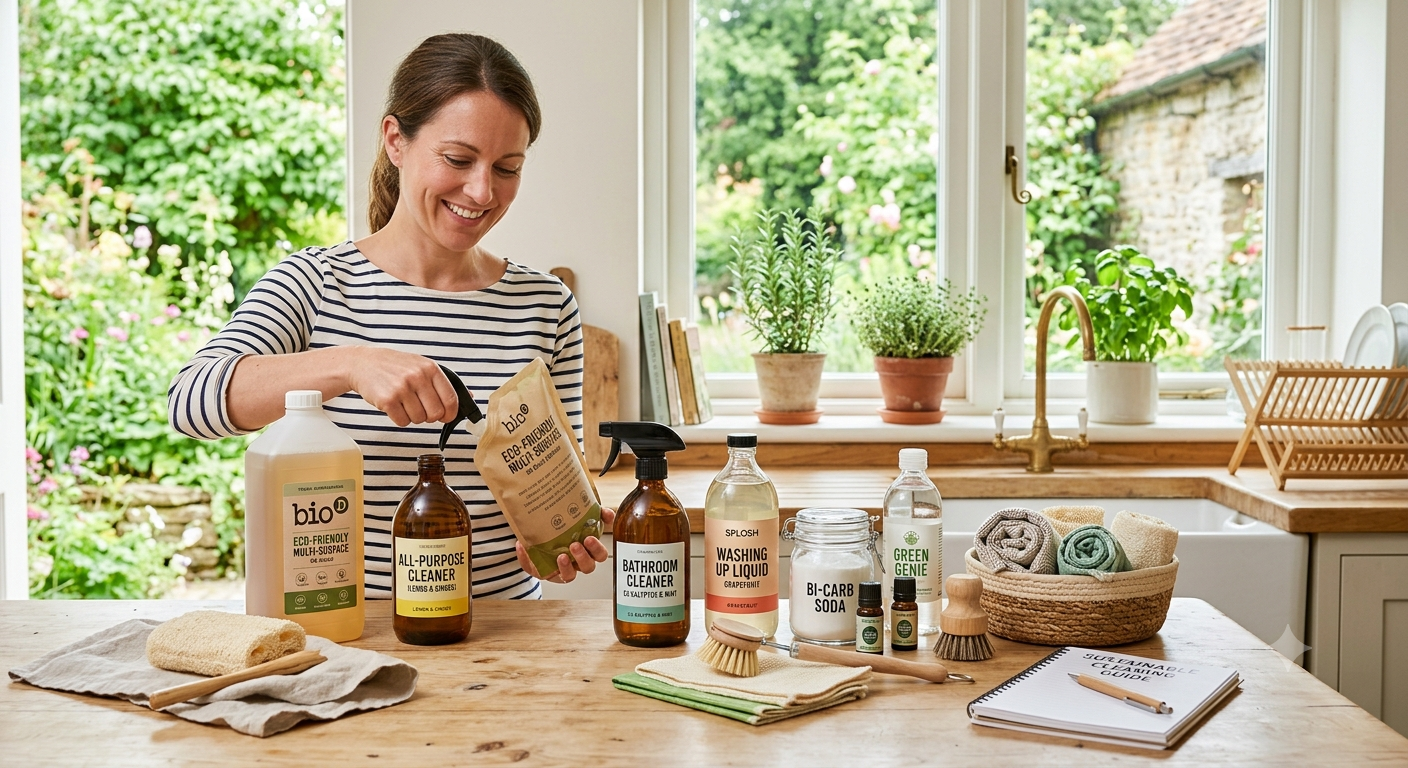
A basic sustainable cleaning kit could contain:
- Reusable spray bottle
- Concentrated multi-surface cleaner
- Eco-friendly washing-up liquid
- Laundry detergent
- Toilet cleaner
- Suitable bathroom cleaner
- Reusable microfibre or washable cloths
- Reusable scrubber
- Glass cleaner if required
- Floor cleaner appropriate for your flooring
Start with the products you already use most frequently.
There is no need to throw away perfectly usable cleaning products simply because you are changing your routine. Replace them gradually as they run out.
10 Easy Eco-Friendly Cleaning Swaps
Want to make your cleaning routine more sustainable without completely changing your lifestyle?
Try these swaps:
1. Disposable wipes → Washable Cloths
Use washable cloths for suitable everyday cleaning tasks.
2. New Spray Bottle → Reusable Bottle
Choose a refill system that allows you to keep the bottle and replace only the cleaning solution.
3. Ready-to-Use Cleaner → Concentrate
Where suitable, choose concentrated products that are diluted according to the manufacturer’s instructions.
4. Disposable Sponges → Reusable Scrubbers
Choose durable cleaning tools that can be washed and reused.
5. Multiple Specialist Cleaners → Suitable Multi-Surface Cleaner
One appropriate product may replace several bottles for everyday cleaning.
6. Excess Detergent → Correct Dosage
Follow the manufacturer’s recommended dosage.
7. Single-Use Packaging → Refill Packs
Choose refill formats where they genuinely reduce packaging.
8. “Eco” Marketing → Evidence-Based Choices
Read the product information rather than buying based only on green colours and leaf logos.
9. Throwaway Cleaning Tools → Durable Alternatives
Buy products designed to be used repeatedly.
10. Automatic Replacement → Buy Only What You Need
A sustainable cleaning cupboard starts with consuming less.
Common Mistakes When Buying Eco-Friendly Cleaning Products
Mistake 1: Assuming “Natural” Means Sustainable
Natural ingredients can still have environmental impacts.
Mistake 2: Focusing Only on Ingredients
Packaging, transport, manufacturing, use and disposal also matter.
Mistake 3: Believing Every Green Label
Look for recognised certifications and supporting evidence.
Mistake 4: Ignoring Product Concentration
A small concentrated bottle may replace several bottles of ready-to-use cleaner.
Mistake 5: Buying Too Many Products
You may not need a separate product for every surface in your home.
Mistake 6: Ignoring Disposal
Always check what happens to the packaging after use.
Mistake 7: Paying More Without Comparing Performance
A sustainable product still needs to do its intended cleaning job effectively.
How to Make Your Cleaning Routine More Sustainable
Buying better products is only part of the solution.
You can also change how you clean.
Use the Correct Amount
Follow dosage instructions instead of assuming more product means better results.
Reuse Containers
Where the system allows it, keep reusable bottles and refill them.
Wash Reusable Cloths Efficiently
Use reusable cleaning cloths and wash them as part of your normal laundry routine where appropriate.
Avoid Unnecessary Disposable Products
Many everyday cleaning jobs can be handled with reusable tools.
Buy Concentrates
Where suitable, concentrates can reduce the volume of product that needs to be packaged and transported.
Keep Products Organised
Storing products correctly can prevent spills, contamination and unnecessary waste.
Buy According to Need
The most sustainable cleaning product is not necessarily the newest product on the shelf. Avoid buying products simply because their packaging looks environmentally friendly.
Are Eco-Friendly Cleaning Products Really Better?
They can be, but it depends on the individual product.
A cleaning product’s environmental performance can be affected by its ingredients, packaging, production, transport, use and disposal.
This is why it is better to compare specific products instead of assuming that an “eco” label automatically makes one product better.
Independent ecolabelling schemes can help. The EU Ecolabel, for example, uses product-specific environmental criteria and also considers product performance.
For shoppers, the simplest approach is to look for specific, evidence-backed claims, minimise unnecessary packaging, consider refills and concentrates, and check disposal instructions.
Frequently Asked Questions About Eco-Friendly Cleaning Products UK
What are the best eco-friendly cleaning products in the UK?
The best option depends on the cleaning task, ingredients, packaging, performance and price per use. Look for products with transparent information, refill or concentrated formats where suitable, and credible environmental certifications.
Are eco-friendly cleaning products as effective as conventional cleaners?
Many sustainable cleaning products are designed to provide effective cleaning performance. However, performance varies by formulation and cleaning task, so choose a product specifically designed for the job.
What is the most environmentally friendly cleaning product?
There is no single product that is automatically the most environmentally friendly. Consider the product’s ingredients, packaging, concentration, manufacturing, use and disposal.
Are eco-friendly cleaning products worth the money?
They can be. Compare the cost per use rather than the purchase price alone. Concentrated and refillable products can sometimes offer better value over time.
What makes a cleaning product sustainable?
Potential factors include reduced packaging, refill systems, concentrated formulas, responsible ingredients, efficient use and credible environmental certification. No single factor tells the whole story.
Where can I buy eco-friendly cleaning products in the UK?
You can find sustainable cleaning products in supermarkets, specialist online retailers, brand websites and local refill or zero-waste shops.
Are refillable cleaning products better for the environment?
Refill systems can reduce packaging waste when the refill format genuinely uses fewer resources and the reusable container is used repeatedly. Compare the complete packaging system rather than assuming every refill is automatically better.
How can I avoid greenwashing when buying cleaning products?
Look for specific claims backed by evidence, read ingredient and packaging information, check certifications and consider how the product and packaging will be disposed of.
How can I make my cleaning routine more sustainable?
Start with simple changes such as using reusable cloths, choosing refillable or concentrated products, measuring detergents correctly, reducing disposable products and buying only what you need.
Final Thoughts
Creating a more sustainable cleaning routine does not require replacing every product in your home overnight.
Start small.
Choose reusable cleaning tools, look for refill or concentrated options, reduce unnecessary packaging and learn to question vague environmental claims.
Most importantly, don’t judge a cleaning product by its green packaging alone. Consider the ingredients, packaging, performance, usage and disposal together.
The goal is not to create a perfectly “green” cleaning cupboard. It is to make practical choices that reduce unnecessary waste and environmental impact while still keeping your home clean.
With the growing availability of refillable, concentrated and certified cleaning products in the UK, creating a more sustainable cleaning routine is becoming easier—and every small change can contribute to more responsible household consumption.

Author: Sustainable Talks
Talk Green. Think Change. Act Sustainably. 🌍 Ideas, stories & actions for a greener future.