Introduction
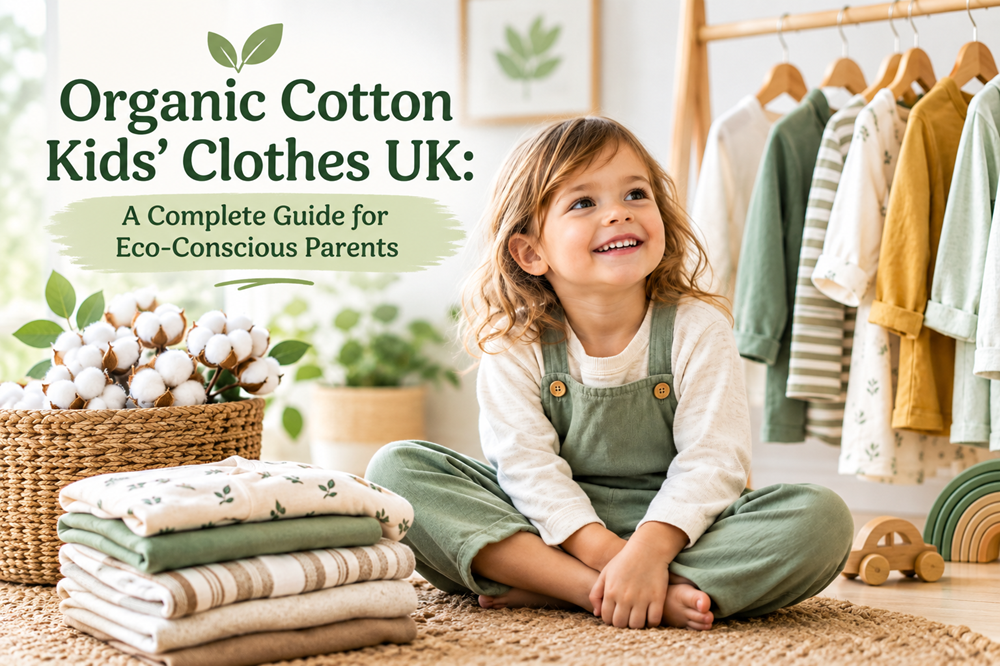
Choosing clothes for children is about more than colours, designs, and sizes. Parents are increasingly considering how clothing is made, what materials it contains, and how long it will last. As awareness of sustainable fashion grows, organic cotton kids’ clothes in the UK are becoming an appealing option for families who want to make more responsible purchasing decisions.
From baby grows and T-shirts to leggings, pyjamas, and everyday outfits, organic cotton can be a practical material for children’s wardrobes. It is soft, versatile, and available in a wide range of styles. However, choosing a garment made from organic cotton does not automatically mean that every part of its production is sustainable.
So, what is organic cotton, and why should UK parents consider it? How can you identify trustworthy certifications, choose high-quality clothing, and reduce fashion waste as your children grow?
This guide explores the benefits, limitations, buying considerations, certifications, and care tips associated with organic cotton kids’ clothes, helping families make informed choices for a more sustainable wardrobe.
What Are Organic Cotton Kids’ Clothes?
Organic cotton kids clothes are garments made wholly or partly from cotton grown according to recognised organic farming standards. Organic cotton production generally restricts certain synthetic pesticides and fertilisers and promotes farming practices intended to support soil health and responsible agricultural management.
The cotton fibre is then processed and turned into fabrics used for children’s clothing, including tops, trousers, dresses, underwear, sleepwear, and baby clothing.
Unlike conventional cotton, organic cotton must meet specific requirements under relevant certification schemes. However, the term “organic cotton” primarily describes the fibre’s farming and sourcing standards. It does not necessarily tell you everything about the dyeing, manufacturing, transport, or working conditions involved in making a finished garment.
For this reason, parents should consider both the material and the wider production process when shopping for sustainable children’s clothing.
Quick answer: Is organic cotton better for children’s clothing?
Organic cotton can be a useful choice for parents who want to explore more sustainable clothing options. It may offer a comfortable, versatile fabric while supporting farming systems with different environmental requirements from conventional cotton. However, its overall impact depends on farming, processing, manufacturing, garment quality, and how long the clothing is used.
Why Choose Organic Cotton Kids’ Clothes in the UK?
There are several reasons parents may consider organic cotton when buying clothing for babies, toddlers, and older children.
1. Comfortable for everyday wear
Cotton is widely used in children’s clothing because it can feel soft and comfortable against the skin. Organic cotton fabrics are available in different weights and weaves, making them suitable for everything from lightweight summer tops to warmer layered outfits.
Comfort also depends on the fabric finish, garment construction, seams, labels, and the individual child’s preferences.
2. Suitable for different seasons
The UK’s changing weather means children often need clothing that can be layered throughout the year. Lightweight organic cotton T-shirts can be useful in warmer weather, while thicker cotton sweatshirts, leggings, and long-sleeved tops can be combined with other layers during cooler months.
Choosing versatile garments can help parents create a practical wardrobe without buying excessive clothing.
3. Potential environmental advantages
Organic cotton farming standards restrict certain synthetic agricultural inputs and may encourage practices that support soil health and biodiversity. Some certified organic production systems also place requirements on water management and other environmental factors.
However, organic cotton is not impact-free. Water use, energy consumption, processing, dyeing, transport, and garment disposal all contribute to a clothing item’s environmental footprint. Parents should therefore consider organic cotton as one part of a broader sustainable fashion approach.
4. A useful option for long-lasting clothing
The durability of children’s clothing depends on the quality of the fabric, stitching, construction, and care. Well-made organic cotton garments may be suitable for frequent use and repeated washing.
Choosing durable pieces that can be passed down to siblings, friends, or other families may help reduce the demand for new clothing.
5. Greater awareness of materials
Buying organic cotton can encourage families to pay closer attention to fibre content, certification, manufacturing, and brand transparency. These habits can help parents make more informed choices across their children’s entire wardrobe.
Organic Cotton vs Conventional Cotton: What Is the Difference?
One of the most common questions from eco-conscious parents is how organic cotton compares with conventional cotton.
| Feature | Organic cotton | Conventional cotton |
| Farming standards | Grown according to recognised organic requirements | Grown under conventional agricultural systems |
| Synthetic agricultural inputs | Certain synthetic pesticides and fertilisers are restricted under organic standards | May be used according to applicable agricultural regulations |
| Certification | May be certified under schemes such as GOTS or OCS | May also have certifications, depending on the product |
| Environmental impact | Depends on farming, processing, and manufacturing practices | Depends on farming, processing, and manufacturing practices |
| Finished garment quality | Depends on fabric and construction | Depends on fabric and construction |
| Sustainability | Requires consideration of the whole product lifecycle | Requires consideration of the whole product lifecycle |
Is organic cotton more sustainable than conventional cotton?
Organic cotton can offer environmental advantages in certain areas, particularly where organic farming standards restrict specific agricultural inputs. However, sustainability comparisons are complex and depend on the farming system, location, yield, irrigation, processing, and other factors.
A responsible comparison should avoid claiming that every organic cotton garment automatically uses less water or has a lower total carbon footprint than every conventional cotton garment.
What Certifications Should UK Parents Look For?
Certifications can help parents assess whether a product’s material or production claims have been independently checked. Different certifications cover different parts of the supply chain, so it is important to understand their scope.
Global Organic Textile Standard (GOTS)
The Global Organic Textile Standard, commonly known as GOTS, is one of the best-known certifications for organic textiles. It includes requirements relating to organic fibres and covers relevant stages of textile processing and manufacturing.
GOTS also includes environmental and social criteria, making it broader than a certification that only verifies the presence of organic cotton.
Parents should look for the relevant certification information and check whether the specific product or supply chain is covered.
Organic Content Standard (OCS)
The Organic Content Standard is designed to verify the presence and amount of organically grown material in a product. It focuses on organic-material content and chain-of-custody requirements.
Unlike GOTS, OCS does not cover the same broad range of environmental and social processing requirements. The two standards should not be treated as interchangeable.
OEKO-TEX
OEKO-TEX labels, such as STANDARD 100, are associated with testing textiles for certain harmful substances. This type of certification addresses chemical safety and is different from organic-farming certification.
A garment can carry an OEKO-TEX label without being made from organic cotton.
Fairtrade Cotton
Fairtrade certification focuses on specific social, economic, and environmental requirements within relevant cotton supply chains. It addresses issues such as producer conditions and fairer trading arrangements.
Fairtrade Cotton and organic certification serve different purposes, although a product may hold more than one certification.
Quick answer: Does GOTS-certified clothing mean a garment is completely sustainable?
No. GOTS certification provides important information about organic textile requirements and certified processing criteria, but no single label guarantees that a garment has no environmental impact. Parents should also consider quality, longevity, packaging, transport, and how the clothing will be used.
How to Choose Organic Cotton Kids’ Clothes in the UK
Finding suitable organic cotton children’s clothing does not have to be difficult. A few practical checks can help parents make better decisions.
1. Check the fibre composition
Read the product description and care label to find out whether the garment is made from 100% organic cotton or a blend.
If a product contains several fibres, check how much organic cotton it actually includes. Clear fibre information is an important sign of transparent product communication.
2. Look for credible certification
If organic claims are important to you, look for recognised certification schemes and information that identifies the certified product or supply chain.
Do not assume that a vague phrase such as “eco cotton” or “naturally better” means that the fabric is certified organic.
3. Prioritise comfort and fit
Children need clothes that allow them to move, play, and rest comfortably. Look for:
- Soft, suitable fabrics.
- Comfortable waistbands.
- Flat or well-finished seams.
- Practical fastenings.
- Appropriate sizing.
- Designs that are easy to put on and remove.
Organic cotton alone does not guarantee that a garment will be comfortable for every child.
4. Choose durable designs
Children’s clothing is often washed frequently and exposed to active play. Check the stitching, hems, buttons, zips, and fabric weight before buying.
Durable garments can be worn for longer, handed down, or resold, helping to reduce unnecessary clothing waste.
5. Consider the UK climate
The UK’s weather varies throughout the year, so versatile clothing can be particularly useful. Consider lightweight layers, long-sleeved tops, cotton leggings, sweatshirts, and comfortable sleepwear.
Buying clothes that work across several seasons may help reduce the need for a large wardrobe.
6. Research the brand
Look for information about:
- Where the clothing is manufactured.
- What materials are used.
- Whether certification claims can be verified.
- How the brand discusses workers and supply chains.
- Its approach to packaging and environmental responsibility.
- Whether it provides clear product-care instructions.
A transparent brand should make it reasonably easy for customers to understand what they are buying.
Best Types of Organic Cotton Clothes for Children
Organic cotton can be used for many everyday children’s garments. The best option depends on the child’s age, activity, comfort, and the season.
Organic cotton baby clothes
Baby grows, bodysuits, sleepsuits, and soft tops are common choices for infants. Parents should prioritise comfortable construction, practical fastenings, appropriate sizing, and easy washing.
For babies, it is also important to follow safe sleep guidance. Clothing should be suitable for the temperature and the baby’s needs.
Organic cotton T-shirts and tops
T-shirts and tops can be useful everyday essentials for toddlers and school-age children. Neutral colours and versatile designs may make it easier to combine garments into multiple outfits.
Organic cotton leggings and trousers
Leggings, joggers, and cotton trousers can be suitable for play, nursery, school, and relaxed days at home. Look for comfortable waistbands and sturdy construction.
Organic cotton dresses and skirts
Organic cotton dresses and skirts can be useful for everyday wear or special occasions. Choosing designs that are comfortable and easy to wash may help extend their use.
Organic cotton pyjamas
Cotton sleepwear is popular because of its comfort and versatility. Choose appropriately sized nightwear and follow the manufacturer’s care and safety instructions.
Organic cotton socks and underwear
These garments are worn close to the body and often require frequent washing. Check the fibre blend, construction, fit, and care instructions before purchasing.
How to Care for Organic Cotton Kids’ Clothes
Proper clothing care can help garments last longer, which is an important part of sustainable fashion.
Wash according to the care label
Always follow the manufacturer’s instructions. Many cotton garments can be washed at moderate or lower temperatures, but the correct setting depends on the fabric and construction.
Avoid unnecessary washing
If a garment is not dirty or sweaty, airing it out may be enough. Washing clothes only when needed can help reduce water and energy use and may extend fabric life.
Use suitable detergents
Choose a detergent appropriate for the garment and follow the recommended dosage. Avoid using harsh treatments unless they are suitable for the fabric.
Dry thoughtfully
Air-drying can help reduce reliance on tumble dryers. However, drying requirements vary, and garments should be dried according to their care instructions.
Treat stains early
Children’s clothes can pick up food, mud, paint, and other stains. Treating stains promptly with a suitable method may reduce the need for repeated washing or aggressive treatments.
Repair and reuse
Small repairs, such as fixing loose hems or replacing buttons, can extend a garment’s useful life. When clothes no longer fit, consider passing them to another child, donating them, selling them, or repurposing the fabric.
How to Build a Sustainable Kids’ Wardrobe on a Budget
Children grow quickly, so buying sustainable clothing does not mean purchasing expensive new items for every stage of childhood.
Buy fewer, more useful pieces
Focus on essential garments that children will wear regularly. A practical wardrobe may be more sustainable than a large collection of rarely used clothes.
Choose versatile clothing
Look for pieces that can be combined in several ways. Simple T-shirts, leggings, jumpers, and layering garments can create multiple outfits.
Shop second-hand
Second-hand clothing can help extend the life of garments and reduce demand for new production. Charity shops, clothing swaps, online resale platforms, and local community groups may all be useful options in the UK.
Consider adjustable designs
Adjustable waistbands, turn-up hems, and flexible fits may allow some garments to remain useful for longer as children grow.
Pass clothes on
When children outgrow good-quality clothing, pass it to siblings, friends, relatives, or other families. Reuse is one of the most practical ways to reduce clothing waste.
Compare value rather than price alone
A low-cost garment may not be good value if it wears out quickly. Equally, an expensive item is not automatically more sustainable. Consider quality, frequency of use, longevity, and the possibility of reuse.
Common Mistakes to Avoid When Buying Organic Cotton Kids’ Clothes
Even well-intentioned shoppers can misunderstand sustainability claims. Here are some common mistakes to avoid.
Mistake 1: Assuming organic means chemical-free
Organic farming standards restrict certain substances, but organic cotton is not grown or processed without any chemicals. Clothing production involves different materials and processes, so “chemical-free” is generally an inaccurate description.
Mistake 2: Believing organic cotton is automatically better for sensitive skin
Organic cotton may feel comfortable, but it is not automatically hypoallergenic or suitable for every child with sensitive skin. Dyes, finishes, seams, detergents, and individual sensitivities also matter.
Mistake 3: Confusing organic cotton with fully sustainable clothing
Organic cotton describes the fibre’s production standards. A garment’s wider environmental and social impact also depends on manufacturing, transport, packaging, durability, and end-of-life treatment.
Mistake 4: Ignoring the clothing’s lifespan
Buying new organic cotton clothing frequently can still contribute to consumption and waste. Choosing fewer, longer-lasting garments and using them for as long as possible is important.
Mistake 5: Assuming a higher price guarantees quality
Price alone cannot prove that a garment is durable, ethically made, or environmentally responsible. Look for evidence, clear product information, and credible certifications.
Frequently Asked Questions About Organic Cotton Kids’ Clothes UK
Are organic cotton kids’ clothes worth buying?
Organic cotton kids’ clothes may be worth considering if you value organic-fibre production standards, comfort, and sustainable purchasing. The best choice depends on the garment’s quality, certification, price, and expected lifespan.
Is organic cotton safe for babies?
Organic cotton is widely used in baby clothing. However, the safety and suitability of a garment depend on its construction, chemical testing where relevant, fit, fastenings, and intended use. Always follow clothing and safe-sleep guidance.
Where can I buy organic cotton kids’ clothes in the UK?
UK parents can explore specialist sustainable clothing retailers, certified textile brands, ethical children’s clothing companies, and selected mainstream retailers offering organic cotton ranges. Before buying, check fibre content, certification, sizing, care instructions, and the retailer’s returns policy.
How do I know if organic cotton clothing is genuinely certified?
Look for the name of the certification scheme and relevant product or supply-chain information. For GOTS, parents can consult the official standard and certification resources. A general statement such as “eco-friendly cotton” is not the same as verified organic certification.
Is organic cotton better than bamboo for children’s clothing?
The answer depends on the specific product and manufacturing process. Organic cotton is a natural fibre with recognised organic farming standards. Bamboo textiles may be produced through different processing methods, and the sustainability of a finished garment depends on the fibre, processing, energy, chemicals, and supply chain involved.
How long do organic cotton kids’ clothes last?
There is no single lifespan for organic cotton clothing. Durability depends on the fabric, stitching, garment design, frequency of use, washing, drying, and how actively the child wears it. Good care and repairs can help extend its useful life.
Can organic cotton clothes be recycled?
Some textile-recycling systems accept cotton garments, but availability varies by location and material. Before recycling, consider whether the clothing can be reused, donated, repaired, or repurposed. Check local UK textile-collection services for accepted materials.
Conclusion: Making More Sustainable Clothing Choices for Children
Choosing organic cotton kids’ clothes in the UK can be one step towards a more thoughtful and sustainable approach to children’s fashion. Organic cotton offers an alternative to conventionally grown cotton, and recognised certifications can help parents understand how certain materials and production processes are managed.
However, sustainability is about more than a fabric label. Buying fewer useful garments, choosing durable clothing, caring for items properly, shopping second-hand, and passing clothes on can all make a meaningful difference.
The most sustainable children’s wardrobe is not necessarily the one filled with the most organic clothing. It is one where garments are chosen carefully, worn regularly, cared for responsibly, and kept in use for as long as possible.
By combining informed shopping decisions with practical habits, UK families can help reduce clothing waste while keeping children comfortable, active, and well dressed.
Explore more sustainable living advice on Sustainable Talks for practical ideas, responsible shopping tips, and eco-conscious lifestyle inspiration.

Author: Sustainable Talks
Talk Green. Think Change. Act Sustainably. 🌍 Ideas, stories & actions for a greener future.