



Everyday cleaning choices can have an impact on the environment. One simple place to start is the kitchen sink. Traditional washing-up sponges are often made with synthetic materials, may contain plastic fibres and are regularly thrown away once they become worn or unhygienic.
An eco-friendly kitchen sponge offers a more sustainable alternative. Made from materials such as cellulose, loofah, coconut fibre or other plant-based materials, sustainable sponges can help UK households reduce their reliance on conventional plastic-based cleaning products.
But what makes a kitchen sponge genuinely sustainable? Are biodegradable sponges effective? Can they be composted? And which material should you choose?
This guide explains everything you need to know about eco-friendly kitchen sponges in the UK, including materials, benefits, cleaning performance, disposal and practical tips for choosing a more sustainable option.
What Is an Eco-Friendly Kitchen Sponge?
An eco-friendly kitchen sponge is a cleaning sponge designed to reduce environmental impact compared with conventional synthetic sponges.
Depending on the product, it may be:
- Made from renewable or plant-based materials
- Biodegradable
- Compostable under appropriate conditions
- Plastic-free
- Reusable or longer-lasting
- Produced using lower-impact manufacturing processes
- Packaged without unnecessary plastic
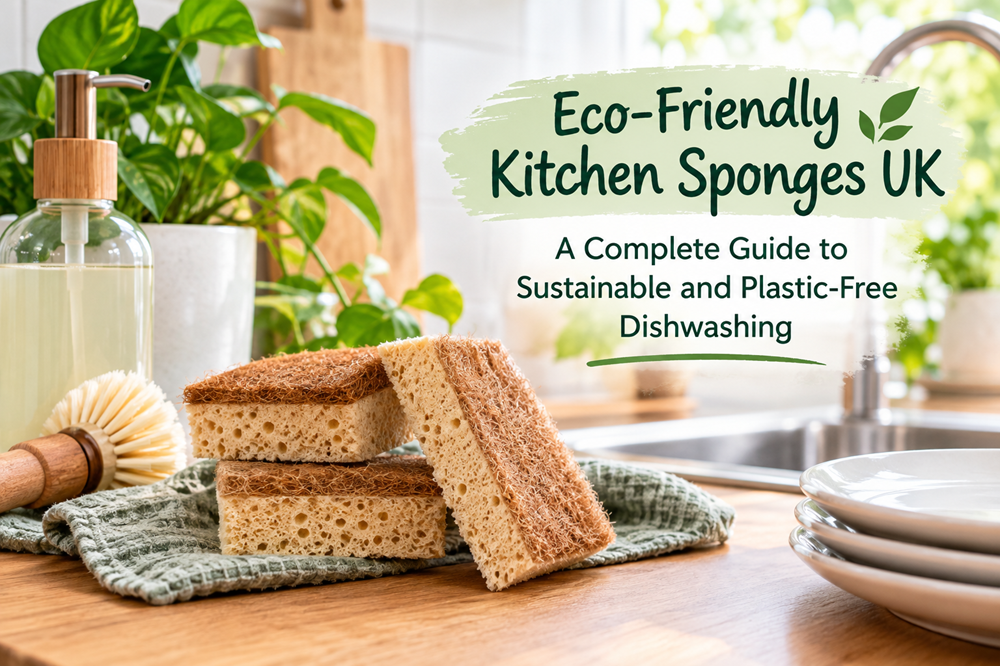
Common materials include cellulose, natural loofah, coconut fibre, sisal and plant-based fibres.
However, the term “eco-friendly” is not automatically a guarantee of sustainability. Always check the material, manufacturing information, packaging and disposal instructions before buying.
Why Consider an Eco-Friendly Kitchen Sponge?
A kitchen sponge may seem like a small household item, but replacing disposable plastic-based products can be one part of a wider low-waste lifestyle.
1. Reduce Plastic Use
Many conventional sponges contain synthetic materials. Choosing a plastic-free alternative can help reduce your dependence on plastic-based household cleaning products.
For households trying to create a plastic-free kitchen, switching to a natural or plant-based sponge can be a straightforward first step.
2. Choose Renewable Materials
Materials such as loofah and cellulose can be derived from plants. Unlike fossil-fuel-based synthetic materials, plant-based resources can be renewable when responsibly grown and managed.
3. Biodegradable Options Can Reduce Long-Term Waste
Some natural sponges can biodegrade at the end of their useful life.
However, “biodegradable” does not necessarily mean that a product will disappear quickly in every environment. Disposal conditions matter, so always follow the manufacturer’s instructions.
4. Reusable Options Can Reduce Consumption
Some sustainable cleaning products are designed to be washed and reused.
A durable reusable sponge or cleaning cloth can potentially reduce how frequently you need to purchase replacements.
5. They Fit a Low-Waste Cleaning Routine
Switching to an eco-friendly sponge can complement other sustainable kitchen choices, including:
- Refillable cleaning products
- Reusable cloths
- Plastic-free washing-up brushes
- Recycled or recyclable packaging
- Concentrated cleaning products
- Reusable food storage
- Composting suitable food waste
What Are Eco-Friendly Kitchen Sponges Made From?
Not all sustainable sponges are made from the same material. Understanding the differences can help you choose the right product.
1. Cellulose Sponges
Cellulose is a plant-derived material commonly used in sustainable cleaning products.
Cellulose sponges are typically soft, absorbent and suitable for everyday washing-up tasks. They can be particularly useful for wiping kitchen surfaces and cleaning dishes.
Potential benefits:
- Plant-based material
- Highly absorbent
- Soft texture
- Suitable for everyday cleaning
- Some options are compostable
Check the manufacturer’s specifications because some cellulose sponges may contain additional materials or synthetic components.
2. Natural Loofah Sponges
Natural loofah is made from the dried fibrous interior of mature loofah plants.
It is a popular choice for plastic-free kitchen cleaning because it is plant-based and can provide gentle scrubbing power.
Loofah can work well for:
- Plates
- Mugs
- Kitchen surfaces
- Pots and pans requiring light scrubbing
Natural loofah can also be cut into different shapes and sizes, making it versatile for household cleaning.
3. Coconut Fibre Sponges
Coconut fibre, also known as coir, comes from the fibrous husk of coconuts.
It is naturally coarse and can therefore be useful when you need stronger scrubbing action.
Coconut fibre cleaning products can be particularly suitable for:
- Pots
- Pans
- Grills
- Tougher food residue
- General kitchen scrubbing
Because the texture can be relatively abrasive, test the sponge carefully on delicate surfaces.
4. Sisal Sponges
Sisal is a natural fibre obtained from the leaves of the sisal plant.
It is known for its durability and textured surface, making it useful for cleaning jobs where a little more abrasion is required.
5. Plant-Based Sponge Blends
Some manufacturers combine different natural or plant-derived fibres to create products with specific cleaning properties.
For example, a sponge might combine a softer absorbent material with a textured natural fibre for scrubbing.
Always read the ingredient or material information rather than assuming that a product described as “natural” is completely plastic-free.
Eco-Friendly Kitchen Sponge vs Traditional Sponge
The biggest difference is often the material used and what happens to the product at the end of its life.
| Feature | Traditional Synthetic Sponge | Eco-Friendly Alternative |
| Material | Often synthetic | Often plant-based or natural |
| Plastic content | May contain synthetic materials | Some options are plastic-free |
| Biodegradability | Usually limited | Some options are biodegradable |
| Compostability | Generally unsuitable | Some products may be compostable |
| Reusability | Depends on product | Depends on product |
| Packaging | Varies | Plastic-free options available |
| Scrubbing power | Usually good | Depends on material |
| Environmental impact | Depends on materials and lifespan | Depends on materials, production and disposal |
It is important to remember that sustainability is not determined by one feature alone. A long-lasting product that is used many times may have different environmental advantages from a disposable product, even if both are made from different materials.
What Is the Most Sustainable Material for a Kitchen Sponge?
There is no single material that is automatically the most sustainable in every situation.
A useful approach is to consider the entire product lifecycle:
Raw materials → Manufacturing → Packaging → Transportation → Use → Cleaning → Disposal
For example, a plant-based sponge may have renewable materials but still involve packaging or manufacturing processes that affect its overall footprint.
When choosing a sustainable kitchen sponge, look for:
- Clearly stated materials
- Minimal packaging
- Responsible sourcing information
- Long usable life
- Reusability where practical
- Clear disposal instructions
- Transparent environmental claims
Are Eco-Friendly Kitchen Sponges Effective?
Yes, many eco-friendly kitchen sponges can handle everyday washing-up tasks effectively.
However, performance depends on the material.
Cellulose: Good for absorption and everyday cleaning.
Loofah: Useful for gentle to moderate scrubbing.
Coconut fibre: Suitable for tougher scrubbing jobs.
Sisal: Useful where a textured cleaning surface is needed.
You may find that one sponge is not suitable for every cleaning task. Using different reusable tools for different jobs can sometimes be more practical than expecting one sponge to do everything.
Are Eco-Friendly Kitchen Sponges Hygienic?
Kitchen sponges can harbour microorganisms when they remain damp and are not properly maintained. This applies to both conventional and eco-friendly sponges.
The material itself does not automatically make a sponge hygienic.
To maintain a cleaner sponge:
- Rinse it thoroughly after use.
- Remove food particles.
- Squeeze out excess water.
- Store it somewhere where it can dry properly.
- Replace it when it becomes damaged, develops an unpleasant smell or can no longer be cleaned effectively.
- Follow the manufacturer’s cleaning instructions.
Allowing a sponge to dry between uses can help prevent it from remaining continuously wet.
How Often Should You Replace an Eco-Friendly Kitchen Sponge?
There is no universal replacement schedule.
How long an eco-friendly sponge lasts depends on:
- Frequency of use
- Type of material
- Cleaning method
- How well it dries
- The type of cleaning performed
- Signs of wear
Rather than replacing a sponge simply because a certain number of days have passed, inspect it regularly.
Replace it if it becomes:
- Permanently dirty
- Damaged or falling apart
- Smelly despite cleaning
- Excessively worn
- Difficult to rinse properly
A longer-lasting product can reduce the number of replacements you need to buy.
Can Eco-Friendly Kitchen Sponges Be Composted?
Some natural kitchen sponges can be composted, but not every product marketed as eco-friendly is compostable.
This distinction is important.
Biodegradable means a material can break down naturally under suitable conditions.
Compostable generally refers to a material that can break down into compost under specified conditions.
Before placing a sponge in your compost bin, check:
- The manufacturer’s disposal instructions
- Whether the entire sponge is compostable
- Whether it contains synthetic fibres
- Whether it contains dyes, adhesives or other components
- Whether home composting is supported
Never assume that a product is suitable for home composting simply because it is labelled “natural” or “biodegradable”.
How to Dispose of an Eco-Friendly Kitchen Sponge
The correct disposal method depends on the product.
If It Is Compostable
Follow the manufacturer’s instructions to determine whether it can go into a home composting system or requires commercial composting.
If It Is Biodegradable but Not Compostable
Follow the manufacturer’s recommended disposal route. “Biodegradable” does not automatically mean that it belongs in your home compost bin.
If It Contains Synthetic Materials
It may need to go into general household waste rather than your compost.
The most sustainable approach is usually to use a product for as long as it remains functional and then dispose of it according to its specific material composition.
How to Choose an Eco-Friendly Kitchen Sponge in the UK
With so many products available, shopping can become confusing.
Here are some practical factors to consider.
1. Check the Materials
Look for products that clearly state what they are made from.
Be cautious of vague claims such as:
- “Green”
- “Earth-friendly”
- “Natural”
- “Eco”
without supporting material information.
2. Look for Plastic-Free Options
If reducing household plastic is your priority, check whether the entire sponge is plastic-free, rather than just the packaging.
3. Consider Durability
A sponge that lasts longer may reduce how frequently you need replacements.
4. Check Disposal Instructions
Look for clear information about whether the sponge is:
- Reusable
- Biodegradable
- Compostable
- Recyclable
- General-waste disposable
5. Consider Your Cleaning Needs
Choose the texture based on what you clean.
For delicate surfaces, a softer sponge may be appropriate. For stubborn residue, you may need a more textured natural fibre.
6. Look at Packaging
A genuinely low-waste product can still be unnecessarily packaged in plastic.
Look for minimal, recyclable or plastic-free packaging where possible.
7. Consider Certifications and Transparency
Where relevant, look for credible information about sourcing, production and environmental claims.
Do not rely solely on marketing language.
How to Care for an Eco-Friendly Kitchen Sponge
Good maintenance can help extend the life of your sponge.
Rinse After Every Use
Remove food residue and cleaning product thoroughly.
Keep It Dry
Do not leave the sponge sitting in a pool of water.
Place it somewhere with good airflow.
Avoid Using One Sponge for Everything
You can have separate cleaning tools for:
- Dishes
- Kitchen surfaces
- Sinks
- Tough scrubbing
This can help prevent cross-contamination between different cleaning tasks.
Follow Manufacturer Instructions
Some sustainable sponges can be washed, while others have specific care requirements.
Always follow the product’s instructions.
Plastic-Free Kitchen Cleaning: What Else Can You Replace?
Once you have switched to an eco-friendly kitchen sponge, you can look at other everyday products.
Consider replacing or reducing:
- Disposable kitchen roll
- Plastic cleaning bottles
- Single-use cleaning wipes
- Plastic washing-up brushes
- Disposable scourers
- Individually packaged cleaning products
Potential alternatives include:
- Reusable cotton or plant-fibre cloths
- Wooden washing-up brushes
- Refillable cleaning sprays
- Concentrated cleaning products
- Reusable cleaning pads
- Natural-fibre scrubbers
The goal does not have to be a completely zero-waste kitchen overnight. Small, practical changes can make a sustainable routine easier to maintain.
Final Thoughts: Making Your Kitchen Cleaning Routine More Sustainable
Switching to an eco-friendly kitchen sponge is a small but practical step towards more sustainable household cleaning.
The most important thing is not simply choosing a product labelled “eco-friendly”. Instead, look at the materials, durability, packaging, cleaning performance and end-of-life options.
For UK households, natural materials such as cellulose, loofah, coconut fibre and sisal can provide alternatives to conventional synthetic cleaning products.
You can also make a bigger difference by combining your sponge choice with other low-waste habits, such as using reusable cloths, refillable cleaning products and durable cleaning tools.
Sustainable living does not require perfection. Making thoughtful choices about everyday products can help create a kitchen cleaning routine that is practical, effective and more mindful of environmental impact.
Make More Sustainable Choices with Sustainable Talks
Looking for practical ideas for a greener home and lifestyle?
Explore more sustainability guides, eco-friendly living ideas and practical tips on Sustainable Talks.
Visit: https://sustainablestalks.com/
Eco-Friendly Kitchen Sponge FAQs
The right sponge depends on your cleaning requirements. Cellulose, loofah, coconut fibre and sisal are examples of materials used in sustainable kitchen cleaning products. Compare durability, cleaning performance, plastic content, packaging and disposal options before choosing.
Biodegradable sponges can offer an alternative to products made primarily from synthetic materials, particularly when they are responsibly sourced and correctly disposed of. However, the overall environmental impact depends on the product’s materials, production, lifespan, packaging and disposal.
Natural kitchen sponges can be suitable for everyday cleaning when used and maintained correctly. Keep them clean, rinse them thoroughly and allow them to dry between uses.
Only if the manufacturer confirms that the entire product is suitable for your type of composting. Some products may be compostable commercially but not suitable for home composting.
Some cellulose sponges are plastic-free, but not all products are identical. Check the full material specification before purchasing.
There is no fixed lifespan. It depends on the material, frequency of use, cleaning routine and how quickly it wears. Replace it when it becomes damaged, persistently unpleasant or difficult to clean.
Biodegradable materials can break down naturally under appropriate conditions. Compostable materials are designed to break down into compost under specified composting conditions. Always check the manufacturer’s disposal guidance.
Natural loofah can be useful for washing dishes and cleaning kitchen surfaces, particularly where gentle scrubbing is required. Its suitability depends on the surface and the specific product.
Start by choosing reusable, durable and appropriately sourced cleaning products. Reduce unnecessary packaging, avoid single-use products where practical and dispose of cleaning products according to their material-specific instructions.

Author: Sustainable Talks
Talk Green. Think Change. Act Sustainably. 🌍 Ideas, stories & actions for a greener future.