
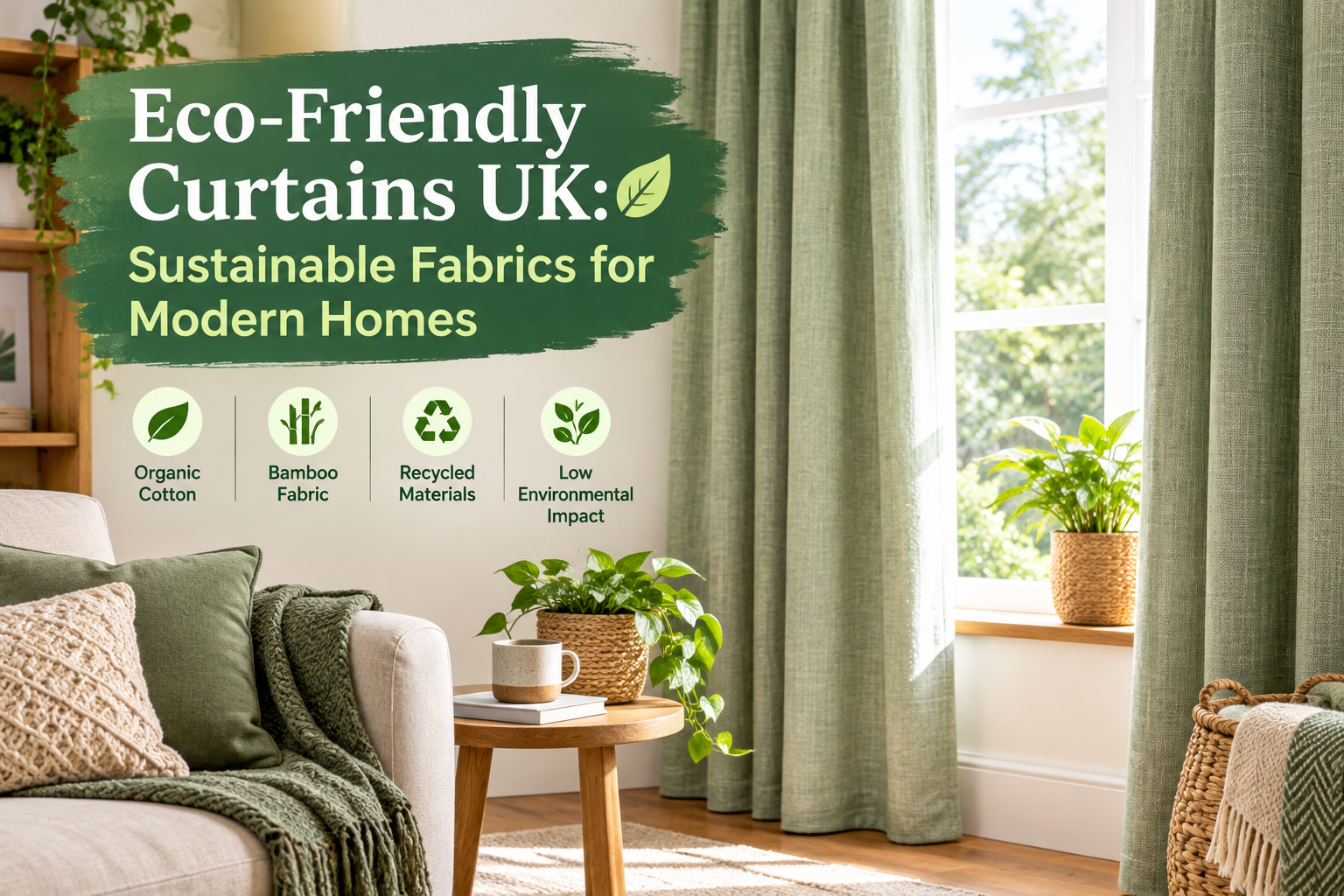
Curtains are an important part of any home. They provide privacy, control natural light, improve comfort and can contribute to the overall style of a room. But when choosing new curtains, sustainability is increasingly becoming an important consideration.
From organic cotton curtains and linen curtains to recycled polyester and hemp fabrics, there are several options for UK homeowners looking to make more environmentally conscious choices.
Choosing eco-friendly curtains in the UK is not simply about finding a fabric labelled “natural” or “green”. A genuinely considered choice involves looking at the material, manufacturing process, durability, certifications, packaging and how the curtains will be used and cared for over their lifetime.
This guide explores the best sustainable curtain fabrics, what to look for when buying eco-friendly curtains and practical ways to make your window treatments more sustainable.
What Are Eco-Friendly Curtains?
Eco-friendly curtains are window coverings designed, manufactured or selected with environmental considerations in mind.
Depending on the product, sustainability may relate to:
- The fibre used
- How the raw material is produced
- Manufacturing processes
- Dyes and finishes
- Energy and water use
- Packaging
- Durability
- Recycled content
- End-of-life options
There isn’t one fabric that is automatically the most sustainable in every situation.
For example, a durable curtain that lasts for many years may be a more practical sustainable choice than a supposedly eco-friendly curtain that needs replacing frequently.
The goal is to consider the whole lifecycle of the curtains.
Why Choose Sustainable Curtains for Your UK Home?
Curtains can last for many years, so choosing carefully can reduce the need for frequent replacement.
1. Reduce Resource Consumption
Choosing durable materials can help extend the useful life of your curtains.
2. Choose More Responsible Materials
Some fabrics use renewable or recycled fibres, offering alternatives to conventional materials.
3. Support Better Manufacturing Practices
Some manufacturers provide information about responsible sourcing, water use, energy consumption and chemical management.
4. Reduce Household Waste
Long-lasting curtains don’t need to be replaced as frequently.
5. Create a More Sustainable Interior
Curtains are just one part of a home’s environmental footprint, but choosing responsibly across multiple interior products can contribute to a lower-waste lifestyle.
10 Sustainable Curtain Fabrics to Consider in the UK
Different materials have different environmental advantages and limitations. Here are some options worth considering.
1. Organic Cotton Curtains
Organic cotton is grown according to organic farming standards, depending on the certification involved.
Compared with conventional cotton, certified organic cotton production can place restrictions on certain synthetic pesticides and fertilisers.
Why consider organic cotton?
- Natural fibre
- Soft and versatile
- Available in many colours and patterns
- Suitable for modern interiors
- Can be durable when properly made
- Available with recognised certifications
When buying organic cotton curtains, look for credible certification rather than relying solely on the phrase “organic cotton”.
2. Linen Curtains
Linen is made from flax fibres and is popular for its natural appearance and lightweight texture.
Linen curtains can work particularly well in minimalist, Scandinavian, coastal and contemporary interiors.
Benefits of linen curtains
- Natural fibre
- Distinctive texture
- Lightweight
- Breathable
- Can be durable
- Often develops a softer appearance with age
Linen can wrinkle more easily than some synthetic fabrics, which may be part of its natural aesthetic.
3. Hemp Curtains
Hemp is another natural fibre that is gaining attention in sustainable textiles.
Hemp plants can grow relatively quickly and can produce strong fibres.
Why consider hemp curtains?
- Natural fibre
- Strong and durable
- Distinctive texture
- Suitable for long-term use
- Can be blended with other fibres
Hemp curtains may be less widely available than cotton or linen, so check the fabric composition carefully.
4. Recycled Polyester Curtains
Not every sustainable curtain needs to be made from a natural fibre.
Some curtains are produced using recycled polyester, often made from recycled plastic materials.
Potential benefits
- Makes use of existing synthetic materials
- Can be durable
- Resistant to creasing
- Available in many colours and styles
- Can be suitable for high-use spaces
However, recycled polyester remains a synthetic fibre. Consumers concerned about fibre shedding should consider the entire product and washing requirements.
5. Recycled Cotton Curtains
Recycled cotton uses existing cotton textile material rather than relying entirely on newly produced cotton fibres.
This can help make use of textile waste.
Things to consider
Recycled fibres can sometimes have different strength characteristics from virgin fibres, so check the product specifications and construction quality.
A blend of recycled and new fibres may be used to achieve the required durability.
6. Tencel™ Curtains
TENCEL™ is a branded fibre made from wood pulp using a controlled manufacturing process.
It is used in various textile applications and can be found in some home furnishing fabrics.
When considering TENCEL™ curtains, check the actual fibre composition and the manufacturer’s sourcing and certification information.
7. Bamboo-Based Curtain Fabrics
Bamboo can be used to create textile fibres, but it is important to distinguish between different bamboo-derived materials.
The environmental impact depends on how the bamboo is processed into fibre.
Don’t assume that a curtain labelled “bamboo” is automatically environmentally friendly. Look for specific information about the fibre production method.
8. Wool Curtains
Wool is a natural animal fibre that can be used in heavier curtains and interior textiles.
It is valued for its durability, texture and thermal properties.
For consumers considering wool, useful questions include:
- Where was the wool sourced?
- How was it produced?
- Is it certified?
- How durable is the fabric?
- Can the curtain be repaired or reused?
9. Reclaimed or Vintage Curtains
One of the lowest-waste approaches can be to avoid buying new curtains altogether.
Second-hand, vintage or reclaimed curtains can give existing textiles another useful life.
Potential sources include:
- Charity shops
- Vintage stores
- Online marketplaces
- Reuse centres
- Local community groups
Check the condition, dimensions and fabric composition before purchasing.
10. Fabric Curtains Made From Deadstock Material
Deadstock fabric refers to unused textile material that may otherwise remain in storage or potentially become waste.
Some curtain makers use leftover or surplus fabrics to create limited-run products.
This can be an interesting option for homeowners looking for unique interiors while making use of existing textile resources.
How to Choose Eco-Friendly Curtains in the UK
Choosing sustainable curtains involves more than selecting a natural-looking fabric.
Check the Fibre Content
Look at the exact composition.
A curtain marketed as “linen” may actually contain a mixture of linen and synthetic fibres.
Understanding the percentages helps you make an informed decision.
Look for Recognised Certifications
Certifications can provide additional information about how materials or products have been produced.
Depending on the material, you may encounter certifications relating to:
- Organic agriculture
- Textile safety
- Responsible forestry
- Recycled content
- Animal welfare
- Manufacturing standards
Always check what the specific certification covers rather than assuming that every certification means the same thing.
Consider Durability
A durable curtain can remain in use for many years.
Look at:
- Fabric weight
- Stitching quality
- Lining
- Hardware
- Colourfastness
- Manufacturer’s care instructions
Buying a product that needs replacing quickly can undermine the benefits of choosing a more sustainable material.
Choose the Right Curtain for the Room
The most sustainable choice is also one that performs well for its intended purpose.
For example:
- Lightweight curtains may work well in rooms where you primarily want privacy.
- Heavier curtains may be useful where light control is important.
- Thermal curtains can be useful in colder rooms.
- Blackout curtains may be suitable for bedrooms.
Choosing the correct product can help prevent premature replacement.
Are Thermal Curtains Eco-Friendly?
Thermal curtains can help reduce heat loss around windows by providing an additional barrier between the room and the window.
Their effectiveness depends on factors including:
- Fabric construction
- Lining
- Window quality
- Fit
- Installation
- Room conditions
Thermal curtains should not be considered a substitute for proper insulation or energy-efficient windows, but they can be one component of a home’s overall approach to energy efficiency.
Are Blackout Curtains Sustainable?
Blackout curtains are designed to block or significantly reduce incoming light.
They can be useful in bedrooms and rooms where controlling sunlight is important.
However, blackout curtains often contain specialist coatings or synthetic components.
If sustainability is important, check:
- Fibre composition
- Coating materials
- Durability
- Packaging
- Manufacturer information
Choose a blackout curtain that meets your needs without unnecessary features.
What Is the Most Sustainable Curtain Fabric?
There is no single answer.
The environmental impact of a curtain depends on multiple factors, including:
Raw material → fibre production → manufacturing → transport → use → washing → end of life
A natural fibre is not automatically the lowest-impact choice, and a recycled synthetic fibre is not automatically the highest-impact choice.
Durability and long-term use are especially important.
How to Make Your Existing Curtains More Sustainable
You don’t necessarily need to replace your curtains to make your home more sustainable.
Repair Them
Repair damaged seams, hems or curtain hooks instead of replacing the entire curtain.
Clean Them Carefully
Follow the manufacturer’s care instructions.
Avoid unnecessary washing or dry cleaning when simple maintenance is sufficient.
Reuse Them
Old curtains can potentially be repurposed as:
- Cushion covers
- Draft excluders
- Storage bags
- Fabric for craft projects
- Cleaning cloths
- Other household textiles
Donate Them
If the curtains are still in good condition but no longer suit your home, consider donating or selling them.
Choose Second-Hand
When replacing curtains, consider second-hand options before buying new.
Sustainable Curtain Linings
The lining can be just as important as the main curtain fabric.
Depending on the product, you may find:
- Cotton lining
- Recycled polyester lining
- Thermal lining
- Blackout lining
- Blended fabrics
Check the full construction rather than evaluating sustainability based only on the outer fabric.
A natural curtain with a heavily synthetic lining may have a very different material profile from what you initially expect.
Eco-Friendly Curtain Poles and Accessories
Sustainable window dressing goes beyond fabric.
Consider the materials used for:
- Curtain poles
- Tracks
- Rings
- Hooks
- Tie-backs
- Brackets
Durable metal or responsibly sourced wooden components can potentially last for many years.
The most sustainable option is often one that can be repaired or reused rather than replaced.
How to Care for Sustainable Curtains
Proper care can significantly extend the life of curtains.
Follow the Care Label
Always follow the manufacturer’s cleaning instructions.
Avoid Overwashing
Curtains don’t necessarily need frequent washing unless they become visibly dirty or the manufacturer recommends regular cleaning.
Vacuum Gently
Using a suitable vacuum attachment can help remove dust.
Air Them
Regular ventilation can help keep curtains fresh.
Repair Early
Fix loose stitching, damaged hems or broken hooks before small problems become larger ones.
Protect From Excessive Sunlight
Strong sunlight can gradually fade some fabrics. Suitable blinds, liners or curtains can help manage direct exposure.
How to Avoid Greenwashing When Buying Curtains
The term “eco-friendly” can be used broadly in interior design marketing.
Be cautious of vague statements such as:
- “100% eco”
- “Green fabric”
- “Planet-friendly”
- “Natural and sustainable”
- “Earth-conscious”
Instead, ask for specific information about:
- Fibre content
- Recycled content
- Certification
- Manufacturing location
- Packaging
- Durability
- End-of-life options
The more specific the information, the easier it is to compare products.
Eco-Friendly Curtains UK: Buying Checklist
Before buying new curtains, ask:
☐ What is the exact fibre composition?
☐ Is the material certified where relevant?
☐ Is recycled or organic content used?
☐ Is the curtain durable enough for long-term use?
☐ Is the lining also sustainably considered?
☐ Can the curtains be repaired?
☐ Are the curtain poles and accessories durable?
☐ Is the packaging recyclable or minimal?
☐ Does the manufacturer provide clear sustainability information?
☐ Could I buy second-hand instead?
Final Thoughts
Choosing eco-friendly curtains in the UK is about making informed decisions rather than finding one supposedly perfect fabric.
Organic cotton, linen, hemp, recycled textiles, responsibly sourced wool, TENCEL™ and reclaimed or second-hand curtains can all have a place in a more sustainable home.
However, the material is only part of the story. Consider durability, manufacturing, certification, packaging, care requirements and what happens to the curtains when they are eventually no longer needed.
For many households, one of the most sustainable approaches is simply to keep existing curtains in use for longer. Repairing, cleaning carefully, reusing and buying second-hand can all reduce the demand for new products.
When you do need new curtains, choose materials and products that are suitable for your home, durable enough to last and supported by transparent sustainability information.
A sustainable home isn’t about perfection. It is about making thoughtful choices that reduce unnecessary consumption while creating a comfortable and beautiful living space.
Create a More Sustainable Home With Sustainable Talks
Looking for more ideas for an eco-friendly UK home?
Explore Sustainable Talks for practical guides on sustainable interiors, eco-friendly home products, greener living and responsible shopping.
Explore more sustainable living guides: https://sustainablestalks.com/blog/
Frequently Asked Questions About Eco-Friendly Curtains UK
There is no single curtain type that is automatically the most sustainable. Options such as organic cotton, linen, hemp, recycled textiles, responsibly sourced wool and second-hand curtains can all be considered depending on sourcing, durability and use.
Linen is a natural fibre made from flax and can be a durable curtain material. Its overall environmental impact depends on cultivation, processing, manufacturing and product lifespan.
Certified organic cotton is produced according to specific organic production standards. However, the sustainability of a finished curtain also depends on manufacturing, dyeing, transport, durability and care.
Recycled polyester makes use of existing synthetic material and can reduce the need for virgin polyester. However, it remains a synthetic fibre, so consider the complete lifecycle of the curtain.
There is no universal “best” fabric. Choose a durable material that suits the room, is responsibly sourced where possible and can remain in use for many years.
Thermal curtains can contribute to a more comfortable room and may help reduce heat transfer around windows. Their environmental impact depends on their materials, manufacturing and lifespan.
Keep existing curtains for as long as possible, repair them when necessary, wash them according to care instructions, donate usable curtains and consider second-hand options when replacing them.
Some textile recycling schemes accept curtains, but availability varies across the UK. Check your local council or textile recycling service before putting curtains in household recycling.
Reusing existing curtains can avoid the need to manufacture a new product and can extend the life of existing textiles. Check their condition, cleanliness and suitability before purchasing.

Author: Sustainable Talks
Talk Green. Think Change. Act Sustainably. 🌍 Ideas, stories & actions for a greener future.