
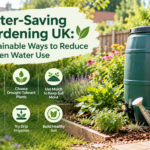


Water is an essential part of a healthy garden, but traditional gardening habits can sometimes use more water than necessary. From frequently watering lawns to using drinking water for containers and flower beds, small amounts of waste can add up over time.
Water-saving gardening in the UK is about creating a healthy, attractive garden while using water more efficiently. Simple changes such as collecting rainwater, improving soil, choosing drought-tolerant plants and watering at the right time can significantly reduce unnecessary water use.
Whether you have a small urban garden, a large lawn, a balcony or a vegetable patch, there are practical ways to make your outdoor space more water-efficient.
What Is Water-Saving Gardening?
Water-saving gardening means designing and maintaining a garden so that plants receive the water they need without unnecessary waste.
It can involve:
- Collecting and using rainwater
- Improving soil moisture retention
- Choosing plants suited to UK conditions
- Mulching garden beds
- Watering deeply rather than frequently
- Reducing unnecessary lawn watering
- Using efficient irrigation methods
- Watering at appropriate times
- Reusing suitable household water where appropriate
- Creating planting areas that require less irrigation
The goal is not to stop watering altogether. Instead, it is to use water efficiently and give plants the right amount at the right time.
Why Is Water-Saving Gardening Important in the UK?
Although the UK is known for its relatively wet climate, rainfall is not evenly distributed throughout the year or across different regions.
Longer dry periods can place pressure on gardens, particularly during spring and summer. Newly planted trees, vegetables, containers and lawns can require additional water during dry weather.
Water-saving gardening can help:
- Reduce household water consumption
- Lower dependence on mains water
- Make gardens more resilient during dry periods
- Protect plants from drought stress
- Reduce water waste
- Support more sustainable gardening
- Encourage healthier soil
- Reduce the time spent watering
- Make gardens easier to maintain
A water-efficient garden can also be more resilient because healthy soil and appropriate plant selection help plants cope better with periods of limited rainfall.
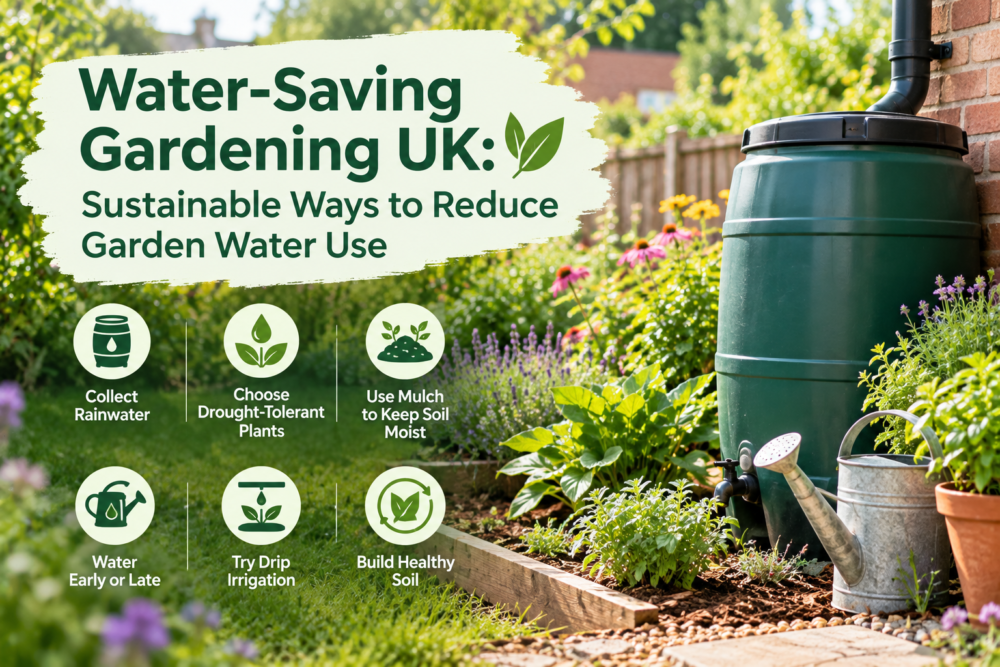
1. Collect Rainwater for Your Garden
One of the simplest ways to reduce mains water use is to collect rainwater.
A water butt can collect rainwater from your home’s roof through a downpipe. The stored water can then be used for many garden tasks.
Rainwater can be particularly useful for:
- Watering flower beds
- Watering vegetable gardens
- Watering containers
- Establishing new plants
- Filling watering cans
- Cleaning some garden equipment
How much rainwater can you collect?
The amount depends on:
- Roof size
- Local rainfall
- Collection efficiency
- Water-butt capacity
- How often you use the stored water
Even a relatively small water butt can provide a useful supply during dry periods.
Tip
Position your water butt close to a suitable downpipe and use a secure lid or covered system to reduce contamination and improve safety.
2. Water Plants at the Right Time
When you water can make a significant difference to how efficiently plants use that water.
During warm weather, watering in the early morning or later in the evening can reduce losses caused by evaporation.
Avoid watering during the hottest part of the day whenever practical.
Morning watering can also allow plants to access moisture before temperatures rise.
For established plants, however, watering should generally be based on actual soil moisture and weather conditions rather than following a rigid daily schedule.
3. Water Deeply Instead of Frequently
Frequent, shallow watering can encourage plants to rely on moisture near the soil surface.
Where appropriate, watering more thoroughly but less frequently can encourage roots to access moisture deeper in the soil.
This approach is particularly useful for established shrubs, trees and many garden plants.
However, newly planted plants may require more regular watering while their root systems become established.
A useful rule
Before watering, check the soil.
Push your finger a few centimetres into the soil near the plant. If it is still reasonably moist, additional watering may not be necessary.
4. Use Mulch to Keep Soil Moist
Mulching is one of the most useful techniques for water-saving gardening.
A layer of suitable organic mulch placed around plants can help:
- Reduce evaporation
- Keep soil cooler
- Suppress weeds
- Improve soil structure
- Add organic matter
- Protect soil from drying out
Possible mulch materials include:
- Well-rotted garden compost
- Homemade compost
- Wood chips
- Bark
- Leaf mould
- Other suitable organic materials
Apply mulch around plants while avoiding direct contact with stems or trunks.
A mulch layer can gradually break down and contribute organic matter to the soil.
5. Improve Your Soil
Healthy soil can hold and manage water more effectively than compacted or poorly structured soil.
Adding organic matter such as garden compost can improve soil structure and its ability to retain moisture.
For clay soils, organic matter can help improve structure and drainage.
For sandy soils, adding organic matter can help increase moisture retention.
Why soil health matters
Instead of simply adding more water, sustainable gardening looks at why the soil is losing moisture so quickly.
Improving soil can therefore be an important long-term water-saving strategy.
6. Choose Drought-Tolerant Plants
Choosing plants that are suited to your garden’s conditions can reduce the amount of supplemental watering required.
Look for plants that are naturally adapted to relatively dry conditions once established.
Examples can include:
- Lavender
- Rosemary
- Thyme
- Sage
- Sedum
- Yarrow
- Verbena
- Some ornamental grasses
- Many Mediterranean-style plants
However, plant suitability depends on your garden’s soil, light, drainage and local conditions.
Important UK gardening tip
“Drought-tolerant” does not mean a plant never needs water.
Newly planted specimens usually need regular watering while their roots establish. Once established, some plants can cope with dry conditions much better than others.
7. Reduce the Amount of Lawn You Need to Water
Lawns can become brown during extended dry periods. In many cases, established grass can survive periods of drought and recover when rainfall returns.
Instead of trying to maintain a perfectly green lawn throughout every dry spell, consider:
- Raising the mowing height
- Avoiding excessive mowing
- Leaving suitable grass clippings on the lawn
- Improving soil health
- Reducing unnecessary watering
- Allowing some areas to grow longer
- Replacing parts of the lawn with suitable planting
A slightly longer lawn can also provide additional habitat and support garden biodiversity.
8. Mow Your Lawn at a Suitable Height
Very short grass can be more vulnerable to heat and drought stress.
Keeping grass slightly longer can provide more leaf area and shade the soil surface.
During dry weather, avoid aggressive mowing and keep mower blades sharp.
If conditions are particularly dry, you may choose to mow less frequently.
9. Use Drip Irrigation for Targeted Watering
If irrigation is necessary, consider systems that deliver water directly to the soil around plants.
Drip irrigation can provide water close to plant roots rather than spraying a large area.
It can be particularly useful for:
- Vegetable beds
- Greenhouses
- Raised beds
- Containers
- Newly planted borders
- Fruit plants
A timer can help manage watering schedules, but it should not replace checking soil and weather conditions.
10. Use a Watering Can for Small Areas
For smaller gardens, a watering can can be a practical alternative to leaving a hose running.
It gives you greater control over how much water you apply.
Direct the water towards the soil around the plant rather than unnecessarily wetting leaves or surrounding areas.
For containers, water until the root zone has been adequately moistened, while avoiding excessive watering that simply runs through the container.
11. Group Plants According to Their Water Needs
Different plants have different watering requirements.
Instead of placing thirsty plants randomly throughout your garden, group plants with similar water needs together.
For example:
Higher-water areas:
- Some vegetables
- Newly planted plants
- Certain moisture-loving plants
Lower-water areas:
- Lavender
- Rosemary
- Thyme
- Sedum
- Other drought-tolerant plants
This can make irrigation more targeted and reduce unnecessary watering.
12. Choose the Right Plants for the Right Place
The amount of water a plant needs depends partly on its growing conditions.
Before planting, consider:
- Sunlight
- Soil type
- Drainage
- Wind exposure
- Plant maturity
- Local climate
- Available rainfall
A plant that is naturally suited to a sunny, well-drained position may need much less additional water than a plant that struggles in those conditions.
The principle of “right plant, right place” is therefore important for water-efficient gardening.
13. Keep Weeds Under Control
Weeds compete with garden plants for water, nutrients and sunlight.
Keeping planting areas reasonably weed-free can reduce competition for available soil moisture.
Mulching can help with this at the same time as reducing evaporation.
Instead of relying solely on chemical weed control, sustainable gardens can use methods such as:
- Hand weeding
- Hoeing
- Mulching
- Dense planting
- Ground-cover plants
14. Make Container Gardening More Water Efficient
Containers can dry out faster than garden soil, particularly during warm weather.
To reduce water use:
- Choose appropriately sized containers
- Use good-quality growing media
- Add mulch to the surface where appropriate
- Group containers together
- Move vulnerable pots away from excessive wind
- Check moisture regularly
- Use self-watering containers where suitable
- Collect rainwater for watering
Avoid allowing containers to remain permanently waterlogged, as this can damage roots.
15. Use Self-Watering Planters
Self-watering containers can store water in a reservoir and allow plants to draw up moisture as required.
They can be particularly useful for:
- Balconies
- Patios
- Small gardens
- Herbs
- Some vegetables
- Container flowers
They do not eliminate the need for monitoring. You still need to check the reservoir, growing medium and plant condition.
16. Reuse Suitable Water Carefully
Some household water may be suitable for garden use, but you need to consider what the water contains.
For example, water collected from certain household activities may contain detergents, oils, cleaning chemicals or other substances that could harm plants or soil.
If considering greywater reuse, use a properly designed system and follow relevant UK guidance.
Do not assume that all household wastewater is suitable for watering edible crops.
17. Give Newly Planted Trees and Shrubs Extra Attention
Newly planted trees and shrubs are particularly vulnerable because their roots have not yet spread extensively into the surrounding soil.
During dry weather:
- Check the soil moisture.
- Water slowly around the root zone.
- Apply water thoroughly when needed.
- Mulch around the planting area.
- Keep competing weeds under control.
- Continue monitoring during the establishment period.
Once plants become established, their watering requirements may decrease depending on species and weather conditions.
18. Create a Rain Garden
A rain garden is a planted area designed to receive and manage rainwater runoff.
It can help slow the movement of water and provide an attractive habitat for plants and wildlife.
Rain gardens can be particularly useful where surface water naturally collects.
Before creating one, consider:
- Soil type
- Drainage
- Location
- Existing underground services
- Plant selection
- Local flooding conditions
A rain garden is not simply a permanently flooded flower bed. It should be designed around how water moves through your particular garden.
19. Consider Permeable Garden Surfaces
Large areas of impermeable paving can prevent rainwater from soaking naturally into the ground.
Where practical, consider permeable surfaces or planting areas that allow rainwater to infiltrate into the soil.
Options may include:
- Gravel
- Permeable paving
- Planting beds
- Gravel gardens
- Porous surfaces
The right option depends on your garden’s drainage and how the area will be used.
20. Plan Your Garden for Long-Term Water Efficiency
The most effective water-saving garden is usually one that is designed with water requirements in mind from the beginning.
Consider creating zones such as:
Zone 1 – Low water:
Drought-tolerant plants and Mediterranean-style planting.
Zone 2 – Moderate water:
General ornamental plants and established shrubs.
Zone 3 – Higher water:
Vegetables, newly planted areas and plants that need consistently moist soil.
This approach allows you to direct water where it is actually needed.
What Are the Best Water-Saving Gardening Techniques in the UK?
The most useful techniques include:
- Collecting rainwater
- Improving soil with organic matter
- Mulching
- Choosing suitable plants
- Watering deeply when necessary
- Watering at cooler times of day
- Reducing unnecessary lawn watering
- Using targeted irrigation
- Grouping plants according to water requirements
- Monitoring soil moisture
- Reducing unnecessary evaporation
You do not need to implement everything at once. Start with the changes that are easiest for your garden.
How Can I Save Water in My Garden During Summer?
During a dry UK summer, you can reduce garden water use by:
- Installing a water butt
- Checking soil before watering
- Watering early or late
- Mulching borders
- Prioritising newly planted plants
- Avoiding unnecessary lawn watering
- Using a watering can for small areas
- Grouping containers together
- Using targeted irrigation
- Choosing drought-tolerant plants for future planting
Remember that plants differ in their water requirements. Newly planted trees, shrubs, vegetables and containers may need more attention than established plants.
Is Rainwater Better for Plants Than Tap Water?
Rainwater is commonly used for garden watering because it provides an alternative to treated mains water and can be collected locally.
Its suitability depends on how it is collected and stored.
A covered water butt can provide a convenient supply of rainwater for many gardening tasks.
Rainwater collection is particularly valuable during wetter periods because it allows you to store water for use when rainfall is limited.
How Often Should I Water My Garden in the UK?
There is no single watering schedule that works for every UK garden.
Watering frequency depends on:
- Weather
- Season
- Soil type
- Plant species
- Plant age
- Container size
- Sun exposure
- Wind
- Recent rainfall
Instead of watering automatically, check the soil and plant condition.
Newly planted plants generally need more frequent monitoring than established plants.
Should You Water Your Lawn During a Drought?
An established lawn does not necessarily need to remain green throughout a dry period.
Grass can often become dormant during extended dry conditions and recover when rainfall returns.
Rather than using large amounts of water to maintain a bright-green lawn, consider:
- Raising the mowing height
- Mowing less frequently
- Avoiding unnecessary fertiliser
- Improving soil health
- Allowing suitable areas to grow longer
Newly seeded or newly laid lawns are different and may require watering while they establish.
Is a Water Butt Worth It in the UK?
For many UK gardens, a water butt can be a practical way to collect rainwater.
It can help:
- Reduce reliance on mains water
- Store rainfall for dry periods
- Provide water for plants
- Make use of water that would otherwise run away
Choose a capacity appropriate for your roof area, garden size and available space.
How Can I Make a Small Garden More Water Efficient?
Small gardens can become water-efficient without major landscaping.
Try:
- Installing a compact water butt.
- Adding mulch to planting beds.
- Choosing plants suited to your conditions.
- Grouping containers together.
- Using self-watering planters.
- Checking soil before watering.
- Using a watering can for targeted watering.
- Replacing some water-intensive plants with drought-tolerant varieties.
Even a balcony or patio garden can incorporate water-saving principles.
Water-Saving Gardening Checklist
Use this simple checklist to make your garden more water efficient:
☐ Install a water butt
☐ Check soil before watering
☐ Water during cooler parts of the day
☐ Mulch planting beds
☐ Improve soil with organic matter
☐ Choose plants suited to your garden
☐ Group plants according to water requirements
☐ Reduce unnecessary lawn watering
☐ Raise lawn mowing height during dry weather
☐ Use targeted irrigation where appropriate
☐ Monitor newly planted trees and shrubs
☐ Use suitable self-watering containers
☐ Reduce unnecessary paved areas
☐ Consider rainwater-management features
☐ Review your garden’s water use each season
Final Thoughts: Create a More Water-Efficient UK Garden
Water-saving gardening in the UK does not mean having a dry or unattractive garden. It means using water thoughtfully and designing outdoor spaces that work with local weather, soil and plant conditions.
Collecting rainwater, improving soil, mulching, choosing appropriate plants and watering efficiently can all reduce unnecessary water use.
The best approach is to focus on healthy soil, suitable plants and efficient watering rather than simply watering more often.
Whether you are redesigning a large garden or improving a few containers on a patio, small changes can make your outdoor space more sustainable.
For more practical ideas on eco-friendly gardening, sustainable homes and greener living in the UK, explore the latest articles on Sustainable Talks.
Explore more sustainable living ideas: https://sustainablestalks.com/blog/

Author: Sustainable Talks
Talk Green. Think Change. Act Sustainably. 🌍 Ideas, stories & actions for a greener future.