




Laundry is one of those household chores that most people do every week, making it an important area to consider when trying to reduce household waste. From laundry detergent and washing capsules to fabric conditioner bottles, everyday laundry products can generate a significant amount of packaging.
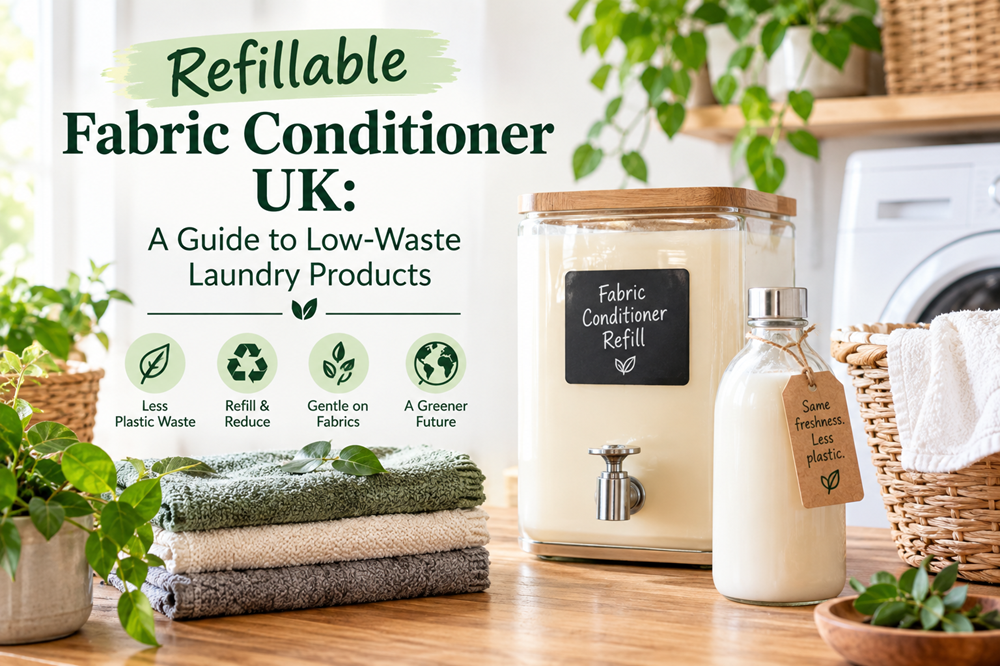
One practical way to reduce packaging waste is to switch to refillable fabric conditioner in the UK.
Refill systems allow you to reuse a container and purchase refills instead of buying a completely new bottle each time. Depending on the brand and packaging system, this can help reduce the amount of packaging used over time.
But how does refillable fabric conditioner work? Is it actually more sustainable? What should you look for when choosing a refillable fabric softener in the UK?
This guide explains everything you need to know about refillable fabric conditioner, from how refill systems work to ingredients, packaging, costs and other ways to make your laundry routine more sustainable.
What Is Refillable Fabric Conditioner?
Refillable fabric conditioner is a laundry product designed to be purchased in a refill format rather than requiring a new primary bottle every time.
Typically, you purchase a reusable bottle or container initially. Once it is empty, you buy a refill and transfer or dispense the product into the original container.
Refills can come in several forms, including:
- Pouches
- Large refill bottles
- Bulk containers
- Concentrated formulas
- Refill stations
- Subscription-based refill systems
The exact process depends on the manufacturer.
The main idea is simple:
Buy once → Reuse the bottle → Refill → Repeat
This can help reduce the number of new bottles entering the household waste stream.
Why Choose Refillable Fabric Conditioner in the UK?
Traditional fabric conditioner is commonly sold in single-use plastic bottles. Although some bottles may be recyclable, recycling still requires resources and energy.
A refill system can encourage reuse before recycling.
Potential benefits include:
1. Less Packaging Waste
If you repeatedly reuse the same bottle, you may need fewer new rigid plastic containers over time.
2. Encourages Reuse
Reuse keeps the original container in service for longer rather than immediately sending it for recycling.
3. Convenient for Regular Laundry
Households that use fabric conditioner frequently may benefit most from refill systems because the bottle can be reused many times.
4. Supports Low-Waste Shopping
Refillable laundry products fit naturally into a broader low-waste household routine.
5. Can Reduce Packaging Per Wash
Depending on the product and refill format, concentrated formulas and larger refill packs may use less packaging relative to the quantity of product supplied.
However, the actual environmental benefit depends on the complete packaging system.
How Does Refillable Fabric Conditioner Work?
The process is usually straightforward.
Step 1: Purchase the Reusable Bottle
Start with the manufacturer’s reusable fabric conditioner bottle.
Step 2: Use the Fabric Conditioner
Use the product according to the manufacturer’s recommended dosage.
Step 3: Clean the Bottle if Required
Follow the manufacturer’s instructions regarding cleaning and drying the container before refilling.
Step 4: Purchase a Refill
Buy the appropriate refill format from the brand.
Step 5: Refill the Container
Transfer or dispense the new fabric conditioner into your reusable bottle according to the manufacturer’s instructions.
Step 6: Repeat
Continue reusing the bottle rather than purchasing a new primary container each time.
What Types of Refillable Fabric Conditioner Are Available?
There isn’t just one refill model.
Refill Pouches
Refill pouches are designed to replenish a reusable bottle.
They can use less rigid plastic than conventional bottles, but the pouch itself still requires materials and may not be accepted in standard household recycling.
Always check the manufacturer’s disposal instructions.
Bulk Refills
Some brands sell larger quantities of fabric conditioner.
A larger container can potentially reduce packaging relative to smaller individual bottles, although this depends on the materials and product concentration.
Refill Stations
Some shops and specialist retailers offer refill stations where customers bring their own containers.
This model can reduce the need for new packaging, although availability varies across the UK.
Concentrated Refills
Concentrated fabric conditioner requires a smaller quantity per wash.
This can potentially reduce packaging and transportation requirements per use.
Always follow dilution and dosage instructions provided by the manufacturer.
Are Refillable Fabric Conditioners More Sustainable?
They can be, but it depends on the entire system.
A refillable product should not automatically be considered more sustainable simply because it uses the word “refill”.
Consider:
- The material used for the original bottle
- How many times the bottle can realistically be reused
- The packaging used for the refill
- Product concentration
- Transportation
- Manufacturing
- Recycling or disposal
- Recommended dosage
For example, a durable reusable bottle combined with efficiently packaged refills may reduce packaging compared with repeatedly purchasing new bottles.
However, the environmental impact of the refill packaging also needs to be considered.
Refillable vs Traditional Fabric Conditioner
| Feature | Traditional Bottle | Refillable System |
| Primary bottle | New bottle for each purchase | Reusable bottle |
| Reuse | Usually limited | Central to the system |
| Refill option | Usually unavailable | Yes |
| Packaging waste | Potentially higher | Can be lower |
| Convenience | Widely available | Depends on availability |
| Storage | Standard | May require refill storage |
| Sustainability | Depends on packaging and formula | Depends on complete refill system |
The most suitable option depends on your household’s laundry habits and access to refill products.
What Should You Look for in a Refillable Fabric Conditioner?
Choosing a refillable product involves more than checking whether the bottle can be reused.
1. Durable Packaging
Choose a bottle designed for repeated use.
A durable container is more useful than a thin bottle that is difficult to reuse.
2. Efficient Refills
Check how much packaging is used for each refill.
A refill system with unnecessarily large or complex packaging may reduce some of the benefits of reuse.
3. Concentrated Formula
A concentrated fabric conditioner may require less product per wash.
Check the manufacturer’s recommended dosage and compare the number of washes provided.
4. Clear Ingredient Information
Look for brands that clearly explain their ingredients.
If environmental claims are important to you, look for specific information rather than vague terms such as “green” or “planet-friendly”.
5. Recyclable Packaging
If the refill packaging is recyclable, check whether your local UK council accepts that particular material.
Recycling rules can differ between local authorities.
6. Transparent Sustainability Claims
A responsible brand should provide useful information about its packaging, ingredients and environmental policies.
Are Refillable Fabric Conditioners Plastic-Free?
Not necessarily.
A refillable fabric conditioner may still contain plastic in:
- The reusable bottle
- Refill pouch
- Cap
- Spout
- Packaging
- Delivery materials
“Refillable” means the primary container can be reused; it does not automatically mean the product is plastic-free.
If eliminating plastic is your goal, investigate the materials used throughout the entire packaging system.
Are Refillable Fabric Conditioners Zero Waste?
Usually, no product should automatically be considered completely “zero waste”.
Refill systems are better understood as a way to reduce waste and encourage reuse.
Even refill products may generate waste from packaging, transportation or unused product.
A more realistic goal is to reduce unnecessary packaging and keep containers in use for as long as possible.
How Much Money Can You Save With Refillable Fabric Conditioner?
The answer depends on:
- Price of the initial bottle
- Price of refills
- Number of washes
- Product concentration
- Dosage
- Frequency of laundry
- Delivery costs
Refillable products are not automatically cheaper.
Before switching, compare the cost per wash, rather than simply comparing the price of bottles.
For example:
Cost per wash = Product price ÷ Number of recommended washes
This gives you a more meaningful comparison between different products.
Is Refillable Fabric Conditioner Better Than Buying Large Bottles?
It depends.
A large conventional bottle may sometimes use less packaging per wash than several small bottles. On the other hand, a reusable bottle with efficient refills can potentially reduce the number of rigid containers used over time.
Compare:
- Total product volume
- Number of washes
- Packaging weight
- Refill packaging
- Product concentration
- Transport requirements
This gives you a more accurate picture than bottle size alone.
How to Store Refillable Fabric Conditioner
Proper storage can help maintain product quality.
Keep fabric conditioner:
- In a cool, dry place
- Away from direct sunlight
- Out of reach of children
- In its intended container
- Properly sealed when not in use
Avoid transferring products into unlabelled containers, particularly in households with children or vulnerable people.
Always follow the manufacturer’s storage instructions.
Can You Reuse Any Fabric Conditioner Bottle?
It is better to follow the manufacturer’s instructions.
Some bottles are designed for repeated refilling, while others may not be suitable for repeated use.
If a brand provides a dedicated refill bottle, use that container rather than improvising with unsuitable packaging.
Never mix different chemical products inside the same container without explicit manufacturer guidance.
How to Use Fabric Conditioner Correctly
Using the correct dosage is important for both performance and waste reduction.
Use the Manufacturer’s Recommended Dose
Do not assume that more conditioner produces softer clothes.
Excess product can be wasteful and may leave unwanted residue.
Use the Correct Compartment
Most washing machines have a dedicated fabric conditioner compartment.
Check your washing machine instructions if you are unsure.
Avoid Using It on Unsuitable Fabrics
Some technical and absorbent fabrics may not perform properly when fabric conditioner is used.
Check the garment care label before adding conditioner.
Do You Need Fabric Conditioner?
No.
Fabric conditioner is an optional laundry product.
Some people use it because they prefer softer-feeling or fragranced clothing, while others choose to skip it entirely.
Reducing your use of unnecessary products can also be part of a low-waste lifestyle.
Consider whether you need fabric conditioner for every wash.
Sustainable Alternatives to Traditional Fabric Conditioner
If your goal is to reduce laundry waste, there are several approaches.
Use Less Product
Follow the recommended dosage and avoid unnecessary overuse.
Skip Conditioner When It Isn’t Needed
Some fabrics and laundry loads may not require it.
Air-Dry Clothes
Line drying can reduce energy use associated with tumble drying.
Wash at Suitable Temperatures
Choose a lower temperature when appropriate for the garment and detergent.
Repair Clothes
Repairing small holes, loose buttons or damaged seams can extend the life of clothing.
Buy Durable Clothing
Choosing well-made garments and caring for them properly can reduce the need for frequent replacement.
How to Avoid Greenwashing in Refillable Laundry Products
The growing interest in sustainable products has also led to an increase in environmental marketing claims.
Look for specific information instead of relying on general phrases.
Vague claim:
“Our revolutionary eco-friendly refill is better for the planet.”
More useful information:
“The reusable bottle is designed for repeated use, while the refill uses X amount of packaging for Y washes.”
Specific information allows consumers to make better comparisons.
Look for brands that explain:
- Packaging materials
- Refill format
- Product concentration
- Ingredients
- Manufacturing
- Certifications
- Disposal instructions
Refillable Fabric Conditioner UK: Quick Buying Checklist
Before purchasing a refillable fabric conditioner, ask:
☐ Is the bottle designed for repeated use?
☐ What material is the refill made from?
☐ Can the refill packaging be recycled?
☐ How many washes does one refill provide?
☐ Is the formula concentrated?
☐ Are the ingredients clearly listed?
☐ Does the brand provide specific sustainability information?
☐ What is the cost per wash?
☐ Is the product suitable for the fabrics you regularly wash?
☐ Can you easily purchase refills in the UK?
Final Thoughts
Switching to refillable fabric conditioner in the UK can be a practical step towards reducing packaging waste and creating a lower-waste laundry routine.
The key is to look beyond the word “refillable”. Consider how durable the bottle is, what the refill is made from, how much product is required per wash and what happens to the packaging at the end of its useful life.
For an even more sustainable laundry routine, combine refillable products with simple habits such as using the correct dosage, washing clothes only when necessary, choosing suitable wash temperatures, air-drying where practical and keeping clothes in use for longer.
Ultimately, sustainable laundry isn’t about finding one perfect product. It is about making informed choices that reduce unnecessary consumption and waste while still meeting the needs of your household.
Start Your Low-Waste Laundry Journey
Looking for more practical ways to make your home more sustainable?
Explore Sustainable Talks for guides covering eco-friendly household products, sustainable living, greener homes and responsible everyday choices.
Explore more sustainable living guides: https://sustainablestalks.com/blog/
Frequently Asked Questions About Refillable Fabric Conditioner UK
Refillable fabric conditioner is designed to allow consumers to reuse a bottle or container and purchase additional product in a refill format rather than buying a completely new bottle each time.
It can reduce packaging waste by encouraging reuse, but the environmental impact depends on the bottle, refill packaging, formula, transportation and how many times the container is reused.
Refillable fabric conditioner may be available through sustainable cleaning brands, online retailers, specialist zero-waste shops and some physical refill stores. Availability varies by location.
Not necessarily. Some refill systems still use plastic packaging. Check the materials used for both the bottle and refill.
Not always. Compare the total cost per wash, including refill prices and delivery charges, rather than comparing the price of individual bottles.
It is best to use a container specifically designed or approved by the manufacturer for refilling. Follow the brand’s cleaning and refill instructions.
It depends on the material and your local recycling system. Always check the packaging label and your local council’s recycling guidance.
A concentrated product may reduce the amount of product and packaging required per wash, but sustainability depends on the entire product lifecycle.
Yes. Fabric conditioner is optional, and many clothes can be washed successfully without it.

Author: Sustainable Talks
Talk Green. Think Change. Act Sustainably. 🌍 Ideas, stories & actions for a greener future.