





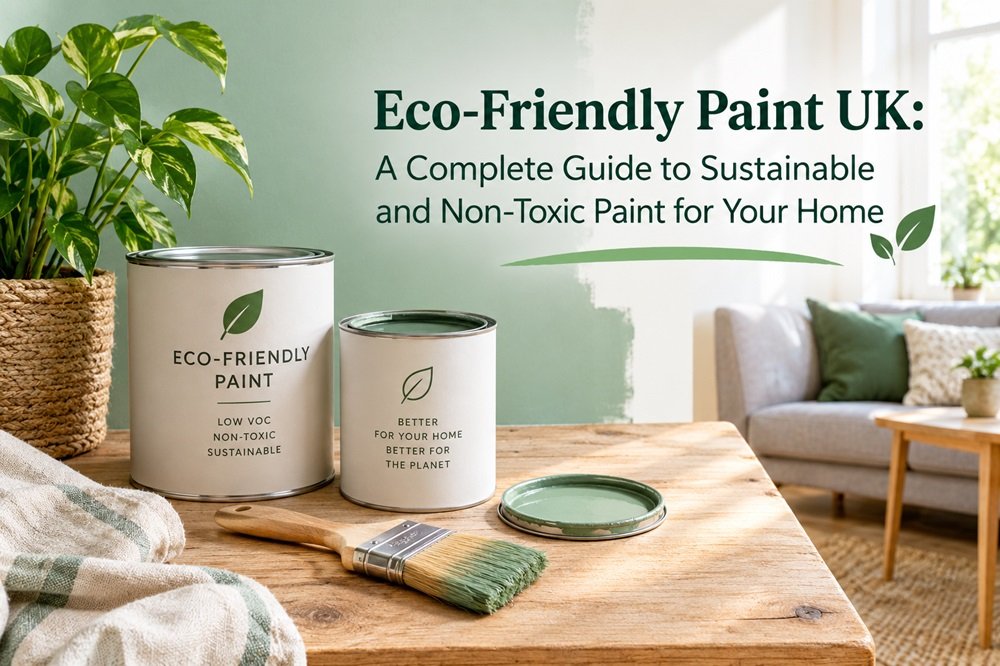
Choosing paint may seem like a simple part of decorating, but the type of paint you use can affect indoor air quality, waste generation and the environmental impact of your home improvement project. With more UK homeowners looking for sustainable alternatives, eco-friendly paint in the UK is becoming an increasingly popular option.
But what actually makes a paint eco-friendly? Is low-VOC paint the same as non-toxic paint? Are natural paints better for the environment? And how can you choose a sustainable paint without compromising on durability or appearance?
This guide explains everything you need to know about eco-friendly, sustainable and non-toxic paint in the UK, including what to look for when buying paint, different types of environmentally friendly paint, their benefits and limitations, and how to dispose of leftover paint responsibly.
What Is Eco-Friendly Paint?
Eco-friendly paint is paint designed to reduce environmental impact through its ingredients, manufacturing, packaging, use and disposal. Depending on the product, this may include lower levels of volatile organic compounds (VOCs), responsibly sourced ingredients, recycled packaging, reduced plastic content, water-based formulations or manufacturing practices designed to reduce waste and emissions.
There is no single ingredient or feature that automatically makes a paint environmentally friendly. Instead, consider the product as a whole.
When choosing sustainable paint, look at:
- VOC content
- Ingredients and formulation
- Water-based versus solvent-based formulation
- Durability and expected lifespan
- Packaging materials
- Recycled or recyclable packaging
- Responsible sourcing
- Manufacturing practices
- Available environmental certifications
- How leftover paint can be reused or disposed of
A genuinely sustainable decorating choice should ideally balance lower environmental impact, good performance and long service life.
Why Choose Eco-Friendly Paint in the UK?
Paint is used extensively in homes, offices and commercial buildings across the UK. Choosing a more environmentally considerate product can form part of a wider sustainable home improvement strategy.
1. Lower VOC emissions
VOCs are chemicals that can evaporate into the air from certain paints and other household products. Paints with lower VOC levels can help reduce emissions during and after decorating.
However, low-VOC does not necessarily mean completely VOC-free or non-toxic. Always check the manufacturer’s product information rather than relying solely on marketing terminology.
2. Better consideration of indoor air quality
Paint can contribute to indoor emissions, particularly while it is drying and curing.
For bedrooms, nurseries and frequently occupied rooms, homeowners may therefore prefer products with lower emissions and clearly disclosed ingredients.
3. Reduced environmental impact
Some sustainable paints are formulated or manufactured with environmental considerations such as renewable raw materials, recycled content or reduced packaging.
These features can help reduce the overall environmental footprint of a decorating project.
4. More sustainable decorating
Eco-friendly paint can complement other sustainable choices such as:
- FSC-certified timber
- Reclaimed furniture
- Organic textiles
- Natural flooring
- Energy-efficient lighting
- Recycled or upcycled décor
- Sustainable insulation
Together, these choices can contribute to a more environmentally conscious home.
What Makes Paint Sustainable?
There are several factors to consider when evaluating whether a paint is sustainable.
Low-VOC Formulation
One of the most commonly discussed features of eco-friendly paint is low VOC content.
VOCs can be released into indoor air as paint dries and cures. Choosing products with lower VOC emissions can reduce the amount of these compounds released into your home.
However, don’t assume that “low VOC” means “chemical-free.” Paint still needs ingredients to provide colour, coverage, adhesion and durability.
Water-Based Paint
Water-based paints use water as a major component of the formulation rather than relying primarily on organic solvents.
They are widely used for interior walls, ceilings, woodwork and other decorating applications.
Water-based paints can offer advantages such as easier clean-up and generally lower odour than many traditional solvent-based alternatives.
Natural Paint
Natural paints may use ingredients derived from natural or renewable sources. Depending on the manufacturer, formulations can include materials such as:
- Clay
- Chalk
- Lime
- Plant oils
- Natural resins
- Mineral pigments
- Natural waxes
However, “natural” does not automatically mean sustainable or harmless. Natural ingredients can still have environmental impacts, and some natural substances may cause sensitivities or other problems for certain people.
Look beyond the label and investigate the actual formulation.
Recycled and Recyclable Packaging
Packaging is another important part of the sustainability equation.
Some manufacturers use recycled plastic or metal containers, while others may offer packaging designed to be easier to recycle.
Before buying, check whether the container and lid can be recycled through your local recycling system.
Durable Formulations
A sustainable paint should ideally last for a reasonable period.
If an inexpensive paint requires frequent repainting because it wears quickly, the environmental impact can increase through additional manufacturing, packaging, transportation and waste.
For this reason, durability matters as much as the ingredients.
What Are VOCs in Paint?
VOCs, or volatile organic compounds, are carbon-based chemicals that can evaporate into the air at room temperature.
They are found in a range of products, including some paints, varnishes, adhesives and cleaning products.
Paint manufacturers may formulate products with different VOC levels, so checking the technical information for a specific product is important.
Are VOCs harmful?
Some VOCs can cause short-term symptoms such as irritation or headaches at sufficiently high concentrations, while certain VOCs are associated with more serious health effects following prolonged or high exposure.
This is why reducing unnecessary VOC emissions can be a sensible consideration when decorating.
Good ventilation during and after painting is also important, even when using low-VOC products.
Is Low-VOC Paint the Same as Non-Toxic Paint?
No. Low-VOC paint and non-toxic paint are not necessarily the same thing.
Low-VOC describes the amount of volatile organic compounds released by a product or contained in its formulation according to the relevant measurement or standard.
“Non-toxic” is a broader marketing term and can mean different things depending on the manufacturer and certification.
When comparing paints, look for:
- Specific VOC information
- Full or meaningful ingredient information where available
- Independent certifications
- Manufacturer technical data
- Application and ventilation instructions
- Information about preservatives, biocides and other additives
Rather than relying on a single phrase such as “natural” or “non-toxic”, assess the complete product information.
Types of Eco-Friendly Paint Available in the UK
There are several categories of paint that may be suitable for a sustainable decorating project.
1. Low-VOC Paint
Low-VOC paints are designed to contain or emit lower quantities of volatile organic compounds than conventional alternatives.
They are available for many interior applications and are often a practical choice for homeowners looking to reduce emissions.
2. Water-Based Paint
Water-based wall and trim paints are widely available in the UK.
They can be used for:
- Walls
- Ceilings
- Skirting boards
- Doors
- Furniture
- Woodwork
Always choose a product designed for the specific surface.
3. Clay Paint
Clay paint is a natural decorating option that can create a soft, matte appearance.
It is often marketed as breathable and is particularly associated with traditional or natural interior design.
However, clay paint may not be suitable for every surface or room, so follow the manufacturer’s preparation and application instructions.
4. Lime Paint
Lime-based paints have a long history in traditional building.
They are particularly associated with masonry and older buildings where breathable finishes can be important.
Because lime paint behaves differently from conventional modern emulsion, surface preparation and application techniques are important.
5. Milk Paint
Milk paint is traditionally made using milk protein, pigments and other ingredients.
It is particularly associated with furniture restoration and decorative finishes rather than standard wall painting.
6. Plant- or Bio-Based Paint
Some modern paints incorporate plant-derived or renewable raw materials.
These can reduce reliance on certain fossil-derived ingredients, although the sustainability of the complete product depends on sourcing, processing, manufacturing and performance.
How to Choose the Best Eco-Friendly Paint in the UK
There is no single eco-friendly paint that is best for every project.
Instead, choose based on the room, surface, performance requirements and environmental criteria that matter most to you.
Step 1: Check the VOC information
Start by checking the product’s VOC classification or technical information.
Lower emissions can be particularly relevant for indoor decorating.
Step 2: Check the ingredients
Look for manufacturers that provide clear information about their formulations.
Avoid choosing a product solely because its packaging uses terms such as “green”, “natural” or “eco”.
Step 3: Look for credible certifications
Independent environmental certifications can provide additional information about a product’s environmental characteristics.
However, certifications can assess different criteria, so check exactly what a certification covers.
Step 4: Consider durability
Ask:
- How many coats are required?
- How long is the expected service life?
- Is it washable?
- Is it suitable for high-traffic areas?
- Will it need frequent touch-ups?
A durable coating can reduce the need for future repainting.
Step 5: Choose the correct paint for the surface
Using the wrong paint can result in peeling, cracking or poor coverage.
Select products specifically designed for:
- Plaster
- Brick
- Wood
- Metal
- Furniture
- Masonry
- Bathrooms
- Kitchens
Step 6: Buy the right quantity
Buying too much paint can lead to unnecessary waste.
Measure your walls carefully and use the manufacturer’s coverage information to estimate how much paint you need.
Step 7: Consider packaging
Where possible, consider products that use recyclable or recycled packaging.
Also look for manufacturers that provide information about responsible disposal.
Eco-Friendly Paint for Different Rooms
Different rooms have different requirements.
Living Room
For living rooms, consider:
- Low-VOC interior paint
- Durable matt or eggshell finishes
- Water-based formulations
- Washable finishes if the room receives heavy use
Bedroom
For bedrooms, homeowners may prioritise products with low emissions and low odour.
Allow adequate ventilation while painting and follow the manufacturer’s drying and re-entry recommendations.
Children’s Bedroom
For children’s rooms, pay particular attention to product specifications and VOC information.
Choose a paint designed for interior use and follow all ventilation and curing instructions.
Kitchen
Kitchen walls can experience moisture, grease and frequent cleaning.
A washable, durable water-based paint may be appropriate depending on the surface.
Bathroom
Bathrooms require paint designed to cope with higher humidity.
Don’t choose a product purely because it has natural ingredients. Make sure it is technically suitable for the environment.
How to Paint Your Home More Sustainably
Choosing eco-friendly paint is only one part of sustainable decorating.
Prepare surfaces properly
Good preparation can extend the life of your paint job.
Clean, repair and prime surfaces where necessary before applying paint.
Use tools efficiently
Clean brushes and rollers properly so they can be reused.
Instead of automatically throwing away decorating tools after one project, invest in durable equipment that can be used repeatedly.
Avoid unnecessary paint waste
Calculate the amount of paint you need before purchasing.
If you have leftover paint, consider whether it can be used for another decorating project.
Donate usable leftover paint
If you have paint that you no longer need but is still usable, consider giving it to a community project, local organisation or another person who can use it.
Store paint correctly
If you need to keep leftover paint, close the container securely and follow the manufacturer’s storage instructions.
Proper storage can help prevent usable paint from becoming waste.
Can Eco-Friendly Paint Be Used on Old Walls?
Yes, eco-friendly paint can generally be used on existing walls, provided the surface is properly prepared and the product is suitable for it.
Before painting:
- Remove loose or flaking paint.
- Clean the surface.
- Repair cracks and imperfections.
- Allow repairs to dry.
- Sand where appropriate.
- Apply primer if required.
- Apply the recommended number of coats.
Older UK properties may require additional consideration, particularly where walls have traditional materials or breathable construction.
For historic or listed properties, check appropriate guidance before choosing a modern coating.
Is Eco-Friendly Paint More Expensive?
Eco-friendly paint can cost more than some conventional paints, but price varies considerably between products and brands.
The purchase price should not be the only consideration.
Think about:
- Coverage per litre
- Number of coats required
- Durability
- Maintenance
- Expected lifespan
- VOC emissions
- Packaging
- Certifications
- Waste generated
A paint with a higher upfront price may provide better value if it offers greater coverage or lasts longer.
How to Dispose of Leftover Paint in the UK
Do not pour leftover paint down sinks, toilets or drains.
Paint should be handled responsibly because it can contain substances that should not enter wastewater systems.
If you have leftover paint:
- Check whether it can be reused.
- Give usable paint to someone who needs it.
- Contact your local council about household paint disposal.
- Take it to an appropriate household waste or recycling facility where accepted.
- Keep paint in its original container where possible and follow local disposal instructions.
Rules and available facilities vary between UK councils, so check the guidance for your local area.
Eco-Friendly Paint Buying Checklist
Before purchasing paint, use this quick checklist:
☐ Check VOC information
☐ Look for transparent product information
☐ Consider credible environmental certifications
☐ Check whether it is water-based
☐ Consider recycled/recyclable packaging
☐ Choose a durable formulation
☐ Confirm that it is suitable for your surface
☐ Calculate how much paint you actually need
☐ Check drying and ventilation instructions
☐ Plan how you will reuse or dispose of leftovers
Common Mistakes When Buying Sustainable Paint
Mistake 1: Assuming “natural” means environmentally friendly
Natural ingredients can still require energy, land, water and transportation.
Always consider the complete product.
Mistake 2: Focusing only on VOCs
VOC content is important, but sustainability involves much more than VOCs.
Packaging, durability, sourcing, manufacturing and waste should also be considered.
Mistake 3: Choosing paint based only on price
The cheapest paint isn’t necessarily the most sustainable option if it requires multiple coats or frequent repainting.
Mistake 4: Ignoring the surface
Even an environmentally preferable paint will perform poorly if it isn’t suitable for the surface.
Mistake 5: Buying too much
Unused paint can eventually become waste.
Measure carefully and purchase according to the manufacturer’s coverage recommendations.
Final Thoughts
Choosing eco-friendly paint in the UK involves more than finding a tin labelled “green” or “natural”. A sustainable approach considers the paint’s VOC emissions, ingredients, packaging, durability, manufacturing and end-of-life disposal.
For many homeowners, a low-VOC, water-based and durable paint can be a practical starting point. Natural options such as clay or lime paint may also be worth considering where they are technically suitable for the property and surface.
The key is to look beyond marketing claims and compare the complete product.
By making informed choices, buying only the amount required and disposing of leftover paint responsibly, you can make your next decorating project a more sustainable part of your home.
Make Your Home More Sustainable with Sustainable Talks
Looking for more practical ideas for sustainable living and eco-friendly home improvements in the UK?
Explore more guides and sustainable living inspiration on Sustainable Talks: https://sustainablestalks.com
Frequently Asked Questions About Eco-Friendly Paint UK
There is no single paint that is universally the most environmentally friendly. Consider VOC emissions, ingredients, sourcing, packaging, manufacturing, durability and disposal when comparing products.
Eco-friendly paint can be a useful choice for homeowners who want to reduce the environmental impact of decorating and consider indoor emissions. The right option depends on the project’s surface, performance requirements and budget.
Look for interior paints with clearly stated VOC information, suitable certifications and transparent product information. Regardless of the paint type, follow application and ventilation instructions.
Water-based paint can have environmental advantages over some solvent-based alternatives, but being water-based alone does not automatically make a product fully sustainable. Consider its complete formulation, VOC emissions, packaging and durability.
Many low-VOC and water-based paints have less odour than some traditional solvent-based products, but odour varies by formulation. Always follow the manufacturer’s ventilation instructions.
Low-VOC paint can reduce VOC emissions compared with higher-VOC alternatives. However, paint selection should also consider performance, ingredients, durability and other environmental factors.
Yes, but choose a product specifically designed for bathrooms or humid environments. Eco-friendly credentials do not replace the need for suitable moisture resistance.
Some eco-friendly and water-based paints are suitable for furniture. Always check the manufacturer’s instructions for the particular material and finish.
Some UK household waste and recycling facilities accept leftover paint, while others have different requirements. Check your local council’s current guidance before taking paint to a facility.
Choose a suitable low-emission paint, buy only what you need, prepare surfaces properly, reuse decorating tools, store usable leftover paint and dispose of unwanted paint through appropriate local facilities.

Author: Sustainable Talks
Talk Green. Think Change. Act Sustainably. 🌍 Ideas, stories & actions for a greener future.